
How Birds Survive Winter, and What Your Feeder Adds
Fluffing, shivering, fat and a deliberate overnight chill keep a chickadee alive. What the long-running Wisconsin studies say your feeder adds on top.
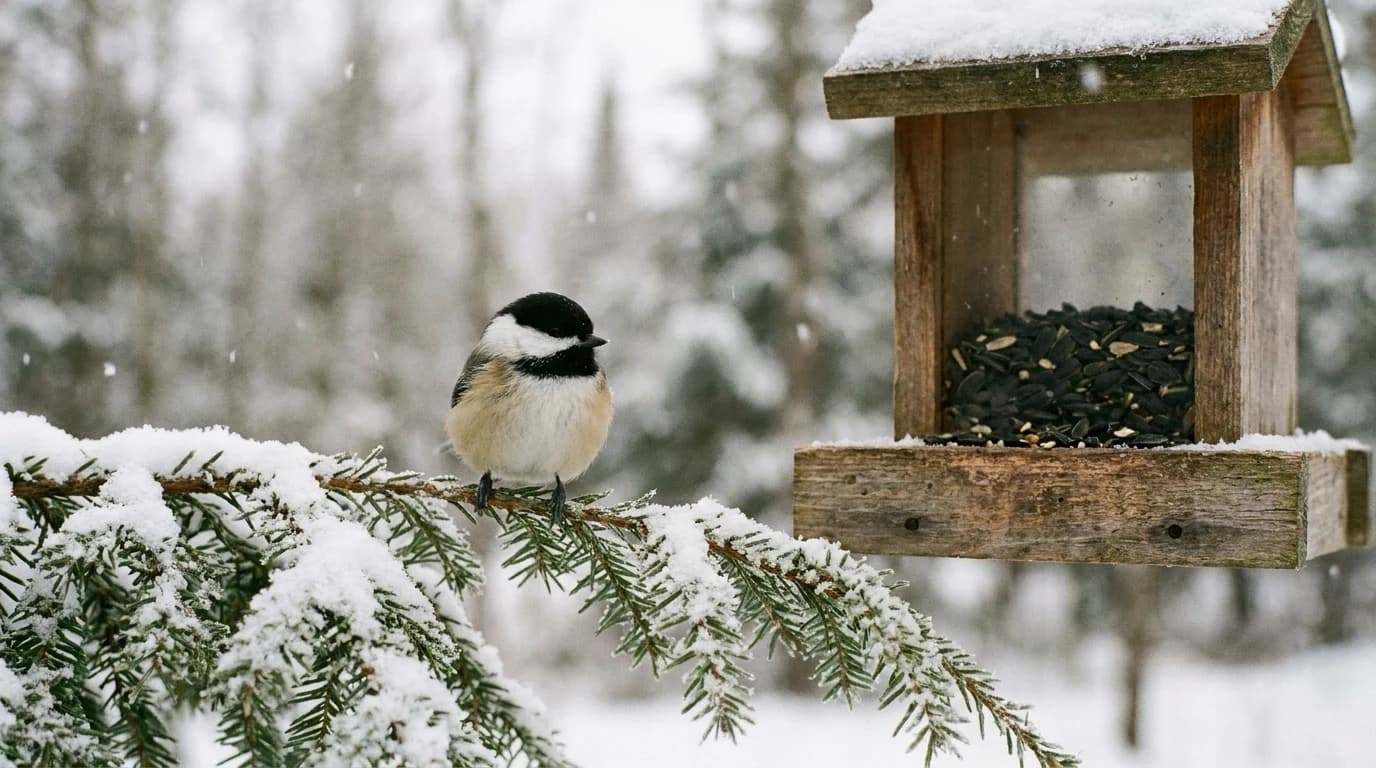
Key takeaways
- The bird does the heavy lifting. Fluffing, shivering, fat reserves, roosting cover and, in chickadees, a controlled overnight drop in body temperature carry it through the night.
- Feeders are a supplement. Brittingham and Temple put the feeder share at about 21% of a chickadee's daily energy; natural food supplied the rest.
- The payoff is in the cold. Fed chickadees survived the winter at 69% vs. 37%, and the gap opened mainly in months with more than five days below about 0°F.
- Dependency didn't show up. At a site fed for 25 winters, previously fed birds survived at 84% a month after removal vs. 85% for never-fed birds.
A chickadee gets through a sub-zero night on its own equipment: fluffed feathers, shivering muscle, a day's worth of fat, and a body temperature it deliberately lets sag after dark. Your feeder doesn't replace any of that. What it does is refill the fat faster, and in the long-running Wisconsin studies, that mattered most in exactly the coldest weeks.
The winter survival kit, trick by trick
Most of what keeps a small bird alive is visible from your window if you know what you're looking at.
| Survival trick | What it does | Birds named by the source |
|---|---|---|
| Fluffing up | Creates hundreds of air pockets between feathers that trap heat (Audubon) | Northern Cardinal |
| Shivering | Burns stored fat to hold body temperature; the U.S. Fish & Wildlife Service says a chickadee can keep 100°F inside while the air sits at 0°F | Black-capped Chickadee |
| Fat stores | Fuel for the night; Audubon puts fat at more than 10% of winter body weight in small birds | Chickadees, finches |
| Letting body temperature drop overnight | Saves fat on cold nights (Jung et al., 2026) | Black-capped Chickadee |
| Huddling and roosting | Shares body heat, or borrows shelter from a cavity (FWS) | Tree swallows huddling; nuthatches, titmice and Downy Woodpeckers in cavities and nest boxes |
| Caching food | Hides seeds in fall for lean days (Audubon) | Chickadees, nuthatches, woodpeckers |
| Countercurrent blood flow in the legs | Keeps cold leg blood from chilling the core (FWS) | Ducks and geese |
Rule of thumb: the puffed-up bird on your feeder isn't sick by default. Fluffing is the first line of the kit, and the cheapest one to run.
The FWS adds the number that explains everything else: chickadees eat more than 35 percent of their body weight every day. A bird that small can't skip a day of eating.
One sub-zero night, in order
Put the kit together and a chickadee's winter night runs roughly like this:
- Dusk: arrive fat. The day's foraging is banked as fat, the only fuel available until sunrise.
- Roost: get out of the wind. Dense evergreens, crooks and cavities. The FWS notes cavity nesters use tree holes and nest boxes for exactly this.
- Fluff and shiver. Insulation holds heat in; shivering makes more of it, paid for in fat.
- Let the thermostat slide. In a 2026 lab study, Jung and colleagues held 10 wild chickadees at 20°C and 3°C. Most ran cooler and lost more fat on the cold nights, and the birds whose temperature dropped further lost less fat overnight. Some never dropped at all.
- Dawn: refuel immediately. Whatever fat is left has to be rebuilt before the next night.
Why dawn matters: step five is the one a feeder touches. Everything else happens in the dark, on the bird's own reserves.
You'll often see step four called torpor. The chickadee paper uses a narrower term, facultative hypothermia: an overnight drop that some birds use and some don't.
What the feeder studies actually measured
This is where the backyard question gets a real answer. Margaret Brittingham and Stanley Temple followed marked Black-capped Chickadees through Wisconsin winters in the 1980s, and three of their findings are worth knowing.
| Question | What they found | Source |
|---|---|---|
| Do fed chickadees survive better? | Over three winters (1982 to 1985), 418 birds with feeder access vs. 158 without: monthly survival 95% vs. 87%, overwinter survival 69% vs. 37%, and 0.13 g more body mass | Ecology, 1988 |
| When did the gap open? | Mainly in months with more than five days below −18°C (about 0°F) | Ecology, 1988 |
| How much of their energy came from feeders? | About 21% of daily energy needs; the rest was natural food | Brittingham & Temple 1992, as summarized by Virginia Cooperative Extension |
| Did long-fed birds crash when the food stopped? | No. After feeders came down at a site fed for 25 winters, 49 previously fed birds had 84% monthly survival vs. 85% for 35 never-fed birds | Conservation Evidence summary of Brittingham & Temple 1992 |
Read those rows together and the picture is consistent: chickadees treat a feeder as a supplement, not a lifeline, yet that supplement is what separated the survivors when the weather turned brutal. The authors suggest the extra fat carried by fed birds may raise survival when foraging gets hard.
The short answer: roughly a fifth of the diet, and the biggest payoff in the coldest weeks.
Newer work points the same way. A 2026 field experiment by Hawkshaw and Mathot found chickadees ran slightly cooler in cold weather when the feeder was empty, a small effect. A 2020 great tit study found that females without a predictable food supply dropped into deeper hypothermia at night, while males did not change.
What a feeder can and can't do
What it can do:
- Top up fat before dusk, so the night starts with a fuller tank
- Make food predictable, which in the great tit study meant shallower overnight chilling in females
- Offer open water when everything else is frozen, if you add a bath
What it can't do:
- Replace natural food. Even fed chickadees took most of their energy elsewhere.
- Stand in for shelter. Roosting cover is the part of the kit you plant, not hang.
- Fix unpredictability on its own. In a captive chickadee study, birds on an erratic food supply carried more fat, and some immune measures declined.
Your winter feeding checklist
| Area | What to do | Why |
|---|---|---|
| Food | Black-oil sunflower, suet, peanuts | Penn State Extension calls black-oil sunflower the best all-round seed for its high oil content; FWS lists all three as high-energy winter foods |
| Water | A heated bath, and never anti-freeze | Penn State notes winter cold can mean drought for birds; FeederWatch warns anti-freeze is poisonous to birds |
| Cleaning | Scrub every week or two, more in heavy use | FeederWatch: leftover seed and hulls can harbor pathogens |
| Placement | Near evergreen cover, about 10 feet from launch points | FeederWatch: evergreens hide birds and buffer winter wind |
A winter kit, one item per row:
- Seed: Wagner's black-oil sunflower
- Fat: Heath's All Season suet in a Stokes Select double suet feeder
- Water: the API Four Seasons heated bath, for when everything else freezes
- Cleaning: a 24-inch Songbird Essentials bottle brush that reaches the bottom of a tube
- Placement: an eWonLife multi-hook feeder pole, so the feeder goes where the cover is, not where a branch happens to be
Our guides to when to start suet, cleaning a feeder and placement go deeper on each row.
If you have to stop for a week in January
The common advice says never stop mid-winter. The 1992 removal study is gentler than that: long-fed chickadees did fine after the food vanished. So a trip is not a death sentence for your regulars.
The 1988 results still say where your effort counts most:
- Keep feeders full through cold snaps. The survival gap opened in the harshest months.
- Refill before dusk on the coldest days. That is the fat that carries a bird to morning.
- If you must pause, pause in a mild spell. Not in the week the forecast drops below 0°F.
Feeding is one of the rare hobbies where the science and the pleasure point the same way. Keep it clean, keep it steady when it's coldest, and the chickadee does the rest on its own.
Frequently asked
Do birds become dependent on feeders?+
The best-known test says no. Brittingham and Temple removed feeders at a Wisconsin site that had been stocked for 25 winters and compared those chickadees with birds that had never been fed. Monthly survival was 84% for the previously fed birds and 85% for the controls. Even with feeders available, chickadees in their work took only about 21% of their daily energy from them.
Is it bad to stop feeding birds in the middle of winter?+
It is not the disaster it is often made out to be, since long-fed chickadees survived normally after feeders came down. But the same researchers found fed birds survived much better in the harshest months, so if you can only keep feeders full some of the time, prioritise cold snaps and refill before dusk on the coldest days.
How do small birds keep their feet from freezing?+
The U.S. Fish and Wildlife Service describes a countercurrent heat exchange in the legs of waterfowl, which keeps cold leg blood from chilling the body, along with scaly feet that limit heat loss. Many ducks, geese, gulls and swans also stand on one leg or sit down to cover their feet.
What is the best food for birds in winter?+
High-energy foods. The U.S. Fish and Wildlife Service suggests suet, peanuts and black-oil sunflower seed, and Penn State Extension calls black-oil sunflower the best all-round seed because of its high oil content and thin shell. Add open water if you can, since frozen weather can leave birds short of it.
Sources & further reading
We research from primary and authoritative sources. Where our guidance rests on a fact, here's where it comes from.
- U.S. Fish & Wildlife Service — How do birds keep warm in the winter? — Chickadees keep a 100°F body temperature at 0°F air and eat more than 35% of body weight daily; preening and air-trapping feathers; tree swallows huddle; nuthatches, titmice and Downy Woodpeckers roost in cavities and boxes; countercurrent heat exchange in waterfowl legs; suet, peanuts, black-oil sunflower and heated baths as winter help
- Audubon Magazine — How Do Birds Cope With Cold Winter Weather? — Fluffing creates air pockets that trap heat; huddling; fat can exceed 10% of winter body weight in small birds like chickadees and finches; caching by chickadees, nuthatches and woodpeckers
- Jung et al. (2026) — Black-capped chickadees use rapid facultative hypothermia to reduce fat loss overnight, Journal of Comparative Physiology B — Abstract: 10 wild chickadees at 20°C vs 3°C; most showed lower body temperature and greater fat loss at 3°C; larger temperature drops meant lower overnight fat loss; some individuals did not drop
- Brittingham & Temple (1988) — Impacts of Supplemental Feeding on Survival Rates of Black-Capped Chickadees, Ecology 69 — Abstract: 418 fed vs 158 unfed chickadees, winters 1982 to 1985; monthly survival 95% vs 87%, overwinter 69% vs 37%, +0.13 g body mass; differences mainly in months with more than 5 days below −18°C
- Conservation Evidence — summary of Brittingham & Temple (1992), Does winter bird feeding promote dependency? Journal of Field Ornithology 63 — After feeder removal at a site fed for 25 winters, 49 previously fed chickadees had 84% monthly survival vs 85% for 35 never-fed controls
- Virginia Cooperative Extension — Feeding Wild Birds: Should People Feed Birds and What's Best to Feed Birds? — Cites Brittingham and Temple 1992 for chickadees taking only 21% of daily energy needs from feeders
- Hawkshaw & Mathot (2026) — Small changes in daytime body temperature in black-capped chickadees in response to supplemental food, Ecology and Evolution — 15 chickadees; lower subcutaneous temperature in colder weather, strongest when the feeder was empty; effects small
- Nilsson et al. (2020) — Predictability of food supply modulates nocturnal hypothermia in a small passerine, Biology Letters — Great tits: females without a predictable food supply entered deeper nocturnal hypothermia; males unchanged
- Cornelius et al. (2017) — Chickadees faced with unpredictable food increase fat reserves but certain components of their immune function decline, Physiological and Biochemical Zoology — Captive chickadees on unpredictable food carried more body and fat mass, with some immune components reduced
- Project FeederWatch (Cornell Lab) — Feeding Birds — Clean feeders every week or two; debris harbors pathogens; never add anti-freeze to baths; place feeders near evergreen cover, about 10 feet from squirrel launch points
- Penn State Extension — Winter Bird Feeding: The Basics — Black-oil sunflower as best all-round seed for its high oil content; winter cold can mean drought for birds; heaters keep water open
Prices and BirdingScores reflect our most recent research and refresh on a cycle; confirm the live price before buying. We may earn a commission from affiliate retailers — it never changes our recommendations. See how we review.