
Tools
Birdhouse hole size and dimensions, by species
The entrance hole decides who moves in. Per Cornell Lab's NestWatch, a bluebird house needs a 1½-inch hole (1 9/16 in for Mountain Bluebirds), a chickadee 1⅛ in, a House Wren 1 in, a titmouse or nuthatch 1¼ in and a Tree Swallow 1⅜ in. Pick a bird for the full box dimensions, or pick the hole you already have to see which birds fit through it.
By BirdingPath Editorial · Last checked
Eastern Bluebird nest box
Entrance hole
1½ in round, or a 1⅜ x 2¼ in oval
Mount it
3–6 ft up
NABS also accepts a 1 9/16 in round hole for all three bluebirds, or a 1⅛ in horizontal slot for Eastern.
NestWatch's plan page says 4–6 ft; NABS says mount the hole at least 5 ft up.
- Inside floor
- 5½ x 5½ in
- Inside depth
- 9 in
- Hole above floor
- 4½–6 in (NABS, floor to bottom of hole)
- Space between boxes
- 300 ft
- Facing
- East, toward open habitat
- Habitat
- Open fields, lawns and orchards with scattered trees.
Predators and competitors
If House Sparrows are a problem, NestWatch suggests drilling a second, identical hole beside the first so bluebirds can defend the box.
Clean out the old nest once a brood fledges so the pair can nest again.
Who else fits through a 1½-inch hole
Same hole size: Western Bluebird, Carolina Wren.
Smaller birds that can also get in: House Wren, Brown-headed Nuthatch, Black-capped Chickadee, Carolina Chickadee, Chestnut-backed Chickadee, Mountain Chickadee, Tufted Titmouse, White-breasted Nuthatch, Red-breasted Nuthatch, Prothonotary Warbler, Tree Swallow, Violet-green Swallow.
House Sparrows: can get in. NestWatch puts their smallest hole at 1¼ in, and no box is fully sparrow-proof, so placement and monitoring matter.
European Starlings: borderline. One NestWatch page says starlings need 1 9/16 in, another says they can't pass a hole smaller than 1½ in.
Fitting through a hole is not the same as choosing the box: floor size, height and habitat do the rest of the sorting.
Houses with a 1½ in hole
From our catalog, matched on the entrance hole each listing states. Check the floor and the clean-out door against the specs above before you buy.
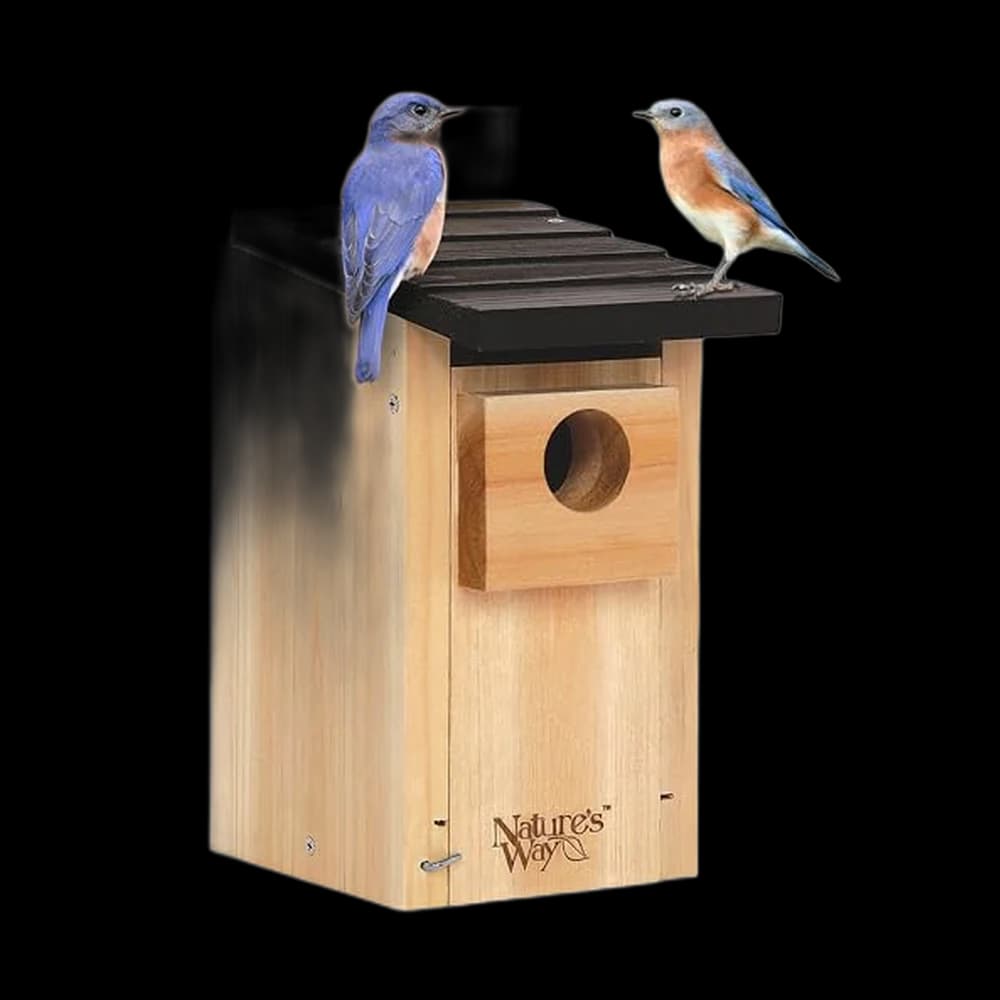
- 4.7$29.99
Bluebird hosts wanting a cedar box with a 1.5-inch hole, wall and floor vents, a clean-out door and a predator-guard entrance.
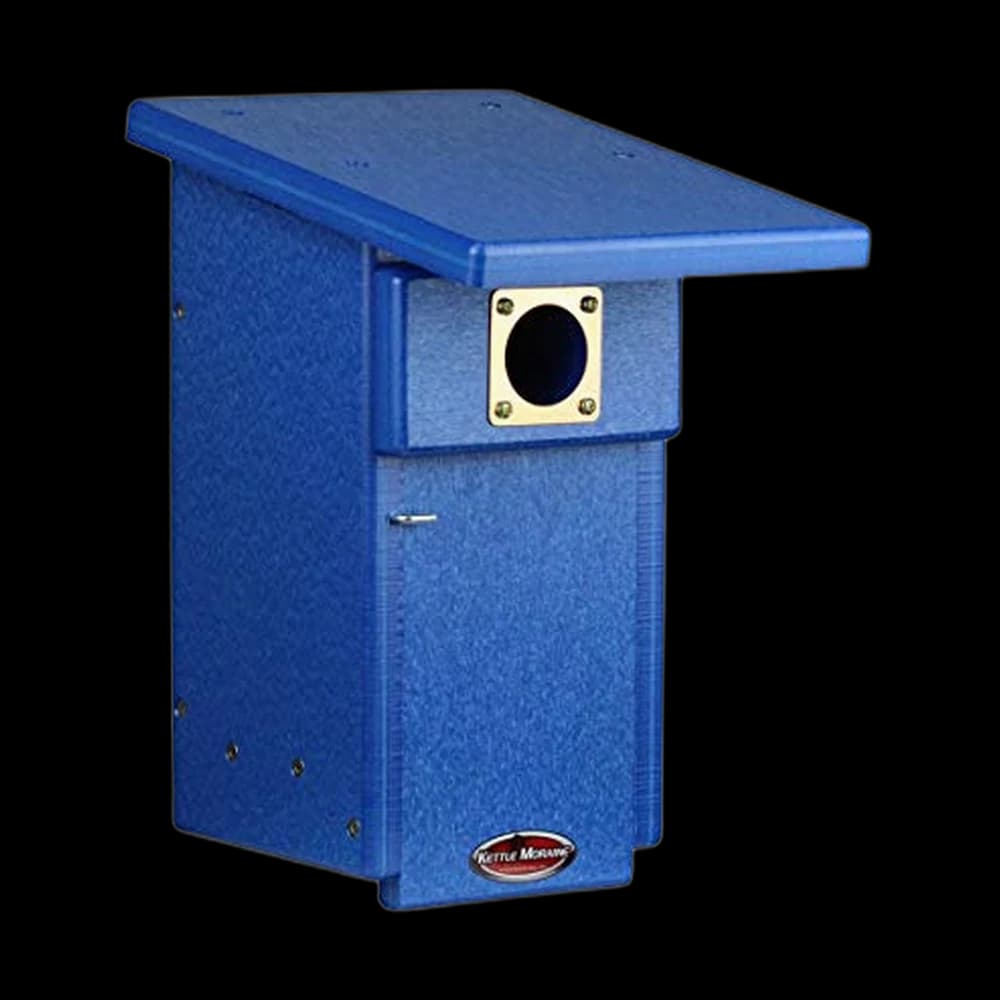
- 4.4$66.00
Eastern-bluebird hosts wanting a NABS-approved recycled-poly box with pole kit and predator baffle included.
Guard the pole. NestWatch describes a cone baffle about 3 ft across or a stovepipe baffle 8 in wide and 24–36 in long; many feeder baffles are smaller, so check the size on the listing. Compare poles and baffles.
Birdhouse hole size chart: 23 species
Hole, mounting height and spacing from NestWatch's requirements table; floor and inside depth from each species' NestWatch plan. “Hole above floor” is from the North American Bluebird Society (N) or Texas Parks & Wildlife (T) where they list it. Scroll the table sideways on a phone.
| Species | Entrance hole | Inside floor | Inside depth | Hole above floor | Mount height | Spacing |
|---|---|---|---|---|---|---|
| Small backyard songbirds | ||||||
| House Wren | 1 in round | 5½ x 5½ in | 8 in | 1–6 in (T) | 5–10 ft | 100 ft |
| Black-capped Chickadee | 1⅛ in round | 5½ x 5½ in | 8 in | — | 5–15 ft | 650 ft |
| Carolina Chickadee | 1⅛ in round | 5½ x 5½ in | 8 in | 6–8 in (T) | 4–15 ft | 30 ft |
| Chestnut-backed Chickadee | 1⅛ in round | 5½ x 5½ in | 8 in | — | 5–15 ft | 160 ft |
| Mountain Chickadee | 1⅛ in round | 5½ x 5½ in | 8 in | — | 5–15 ft | 1 box per 10 acres |
| Tufted Titmouse | 1¼ in round | 5½ x 5½ in | 8 in | 6–8 in (T) | 5–15 ft | 580 ft |
| White-breasted Nuthatch | 1¼ in round | 5½ x 5½ in | 8 in | — | 5–20 ft | 1,040 ft |
| Carolina Wren | 1½ in round, or a 2½ x 5 in slot | 5 x 6½ in | 7 in | 1–6 in (T) | 3–6 ft | 330 ft |
| Bluebirds and swallows | ||||||
| Tree Swallow | 1⅜ in round | 5½ x 5½ in | 9 in | 4½–6 in (N) | 5–6 ft | 35 ft |
| Violet-green Swallow | 1⅜ in round | 5½ x 5½ in | 9 in | — | 9–15 ft | 30 ft |
| Eastern Bluebird | 1½ in round, or a 1⅜ x 2¼ in oval | 5½ x 5½ in | 9 in | 4½–6 in (N) | 3–6 ft | 300 ft |
| Western Bluebird | 1½ in round | 5½ x 5½ in | 9 in | 4½–6 in (N) | 4–6 ft | 215 ft |
| Mountain Bluebird | 1 9/16 in round | 5½ x 5½ in | 9 in | 4½–6 in (N) | 4–6 ft | 300 ft |
| Woodland and wetland birds | ||||||
| Brown-headed Nuthatch | 1 in round | 5½ x 5½ in | 8 in | — | 5–10 ft | 1 box per 6 acres |
| Red-breasted Nuthatch | 1¼ in round | 5½ x 5½ in | 8 in | — | 5–15 ft | 150 ft |
| Prothonotary Warbler | 1¼ in round | 5½ x 5½ in | 8 in | — | 4–12 ft | 235 ft |
| Ash-throated Flycatcher | 1¾ in round | 8 x 7 in | 9 in | — | 3–20 ft | 200 ft |
| Great Crested Flycatcher | 1¾ in round | 8 x 7 in | 9 in | — | 3–20 ft | 1 box per 6 acres |
| Larger birds: flickers, martins, owls, ducks | ||||||
| Purple Martin | 2⅛ in round, or a 3 x 1 3/16 in crescent | — | — | — | 10–15 ft | 10 ft |
| Northern Flicker | 2½ in round | 7¼ x 7¼ in | 24 in | 14–16 in (T) | 6–12 ft | 330 ft |
| American Kestrel | 3 in round | 9⅝ x 11¼ in | 17⅜ in | — | 10–30 ft | ½ mile |
| Eastern Screech-Owl | 3 in round | 9⅝ x 11¼ in | 17⅜ in | 9–12 in (T) | 10–30 ft | 100 ft |
| Wood Duck | 3 in high x 4 in wide oval | 8 x 9¼ in | 24 in | 12–16 in (T) | 6–30 ft | 600 ft |
— means the source doesn't list it. Purple Martins nest in multi-room houses or gourds, and NestWatch's martin page lists no single-box floor.
Where each box goes
The hole lets a bird in; the setting is what makes it choose the box. Habitat paraphrased from NestWatch's table.
- House Wren
- Almost anywhere with shrubs: gardens, parks, farmland and forest edges, within 100 ft of woody cover.
- Brown-headed Nuthatch
- Open pine or pine-hardwood stands, clearings with dead trees and burned areas.
- Black-capped Chickadee
- Yards, woodlots and forest edges with mature hardwoods, in partial sun.
- Carolina Chickadee
- Yards, woodlots, forest edges and meadows with hardwoods, in partial sun.
- Chestnut-backed Chickadee
- Coniferous and mixed forest, thickets and burned areas, often near streams.
- Mountain Chickadee
- Coniferous forest, forest edges and clearings, usually high in the mountains.
- Tufted Titmouse
- Deciduous woods, woodlot edges and riparian areas with large trees.
- White-breasted Nuthatch
- Mature deciduous woods and orchards, often near water.
- Red-breasted Nuthatch
- Mature conifer-dominated or mixed forest, shrublands and suburban parks.
- Prothonotary Warbler
- Flooded lowland hardwoods, swamps and wet bottomlands, with the box over or near water.
- Tree Swallow
- Open fields near water, marshes, meadows and wooded swamps.
- Violet-green Swallow
- Open or broken deciduous and mixed woods and wooded canyons.
- Eastern Bluebird
- Open fields, lawns and orchards with scattered trees.
- Western Bluebird
- Open fields, lawns, orchards and forest edges.
- Carolina Wren
- Dense underbrush, gardens, parks and backyards near trees or shrubs.
- Mountain Bluebird
- Open fields, rural land and forest edges, often in the mountains.
- Ash-throated Flycatcher
- Scrub, mesquite, desert and open deciduous or riparian woods.
- Great Crested Flycatcher
- Deciduous and mixed woods, woodlot edges, orchards and parks.
- Purple Martin
- Broad open areas with no trees or buildings close to the pole.
- Northern Flicker
- Pastures, orchards, meadows, woodlot edges and parks.
- American Kestrel
- Mowed or grazed fields and meadows with lone trees or farm buildings.
- Eastern Screech-Owl
- Forest, parks, clearings, woodland edges and wooded streams.
- Wood Duck
- Forested wetlands, marshes and beaver ponds; the box over water or within 100 ft of it.
The two hole sizes that keep out sparrows and starlings
- 1¼ in: the smallest hole a House Sparrow fits through, per NestWatch. Wren, Brown-headed Nuthatch and chickadee holes are smaller; every other box in the chart lets sparrows in.
- 1½ to 1 9/16 in: the smallest hole a European Starling fits through. NestWatch's birdhouse-features page says 1 9/16 in; its sparrow and starling page says 1½ in. Bluebird holes sit right on that line, which is why the exact size matters.
- Both are invasive. NestWatch says neither is protected by the Migratory Bird Treaty Act, and that no proven method permanently keeps House Sparrows out: siting boxes away from buildings and farmland, and keeping holes plugged until migrants return, are its passive fixes.
Predator guards and mounting
- Pole, not tree or fence post. NestWatch recommends a free-standing metal pole or PVC pipe for small boxes; NABS suggests ½ to ¾-inch electrical conduit and says tree trunks make the box too easy for climbing predators.
- Baffle under the box. NestWatch describes a cone baffle about 3 ft across or a stovepipe baffle about 8 in wide and 24 to 36 in long, which it calls perhaps the most effective.
- Noel guard on the hole. A wire-mesh tube on the front of the box; NestWatch says to pair it with another guard or use it on tree-mounted boxes.
- No perch. NestWatch and NABS both say to leave it off.
State birds that use nest boxes
Northern flicker (Alabama); Mountain bluebird (Idaho, Nevada); Black-capped chickadee (Maine, Massachusetts); Eastern bluebird (Missouri, New York); Carolina wren (South Carolina). Look up any state's bird in the state bird finder.
How this works
Each species' hole, mounting height, spacing and habitat come from Cornell Lab NestWatch's nest box placement table, and its floor, inside depth, facing and tips from that species' NestWatch “Right Bird, Right House” page. NestWatch doesn't give the height of the hole above the floor, so that column uses the North American Bluebird Society's 4½ to 6 inches for bluebirds and Tree Swallow, and Texas Parks & Wildlife's table for 7 other species; where TPWD's hole sizes differ (it lists 1¼ in for House Wren), we follow NestWatch. “Who else fits” lists every species whose listed hole is the same size or smaller than yours, since a bird that fits a 1-inch hole also fits a 1½-inch one; for oval holes it uses the round alternative or the smaller dimension. The houses shown are matched on the entrance hole each catalog listing states. Nothing here is measured by us, and nothing is uploaded: the finder runs in your browser.
For when to put a box up and clean it out, read birdhouse hole sizes by species; for the full bluebird setup, see how to attract bluebirds.
Birdhouse hole size FAQ
What size hole does a bluebird house need?
NestWatch lists a 1½-inch round hole (or a 1⅜ by 2¼-inch oval) for the Eastern Bluebird, 1½ inches for the Western Bluebird and 1 9/16 inches for the Mountain Bluebird. The North American Bluebird Society says a 1 9/16-inch round hole is acceptable for all three, and to use the larger hole where their ranges overlap.
What size birdhouse hole keeps out House Sparrows?
Anything under 1¼ inches: NestWatch says 1¼ inches is the smallest hole a House Sparrow fits through, so wren and chickadee holes keep them out. Bluebirds, swallows and titmice need 1¼ inches or more, and NestWatch says no box is completely sparrow-proof, so siting the box away from buildings matters.
How high off the ground should a birdhouse be?
It depends on the bird. NestWatch's table gives 3 to 6 feet for Eastern Bluebirds, 5 to 10 feet for House Wrens, 5 to 15 feet for Black-capped Chickadees and 10 to 30 feet for kestrels and screech-owls. For bluebirds, NABS says to mount the box with the hole at least 5 feet up.
How far should the entrance hole be from the floor?
For bluebird boxes, the North American Bluebird Society recommends 4½ to 6 inches from the bottom of the hole to the floor, with a rough or grooved inner wall so fledglings can climb out. NestWatch's species pages do not list this figure.
Should a birdhouse have a perch?
No. NestWatch says birds don't need one and it can help predators reach in, and NABS says perches should never be used on bluebird boxes because they help House Sparrows harass the nest.
Can a wren or chickadee use a bluebird house?
Yes. A 1½-inch hole admits every bird with a smaller listed hole, including House Wrens and chickadees. NestWatch notes it is illegal to harm or harass any native species, including its nest and eggs, so a native bird that claims the box keeps it.
Sources
Last checked: .
- NestWatch: Nest Box Placement (requirements table)
- NestWatch: Features of a Good Birdhouse
- NestWatch: Managing House Sparrows and European Starlings
- North American Bluebird Society: Nestbox Recommendations factsheet (PDF, rev. January 2018) (listed on the NABS fact sheets page)
- Texas Parks & Wildlife: Birdhouse dimensions (hole-above-floor figures only)
NestWatch “Right Bird, Right House” species pages
- House Wren
- Brown-headed Nuthatch
- Black-capped Chickadee
- Carolina Chickadee
- Chestnut-backed Chickadee
- Mountain Chickadee
- Tufted Titmouse
- White-breasted Nuthatch
- Red-breasted Nuthatch
- Prothonotary Warbler
- Tree Swallow
- Violet-green Swallow
- Eastern Bluebird
- Western Bluebird
- Carolina Wren
- Mountain Bluebird
- Ash-throated Flycatcher
- Great Crested Flycatcher
- Purple Martin
- Northern Flicker
- American Kestrel
- Eastern Screech-Owl
- Wood Duck