
Birdhouse Hole Sizes by Species (and When to Put One Up)
A 1-inch hole says wren, 1 1/2 says bluebird. Eight backyard species' hole, floor and height from Cornell's NestWatch, plus the fall-to-spring timing.
Key takeaways
- The hole picks the tenant. Most small songbirds share the same 5 1/2-inch NestWatch floor; the entrance diameter is what sorts wrens from chickadees from bluebirds.
- Two numbers keep out invasives. NestWatch says starlings need 1 9/16 inches and House Sparrows 1 1/4 inches, so every songbird box here excludes starlings but not every one excludes sparrows.
- No perch, yes vents. NestWatch's checklist wants drainage holes, side vents, a sloped overhanging roof and an opening side, and no outside perch, which only helps predators.
- Fall is cleaning season. NestWatch says it is fine to clean boxes in fall once nothing is active; have them up by February in the south or mid to late March in the north.
The entrance hole decides who moves in. A 1-inch hole suits a House Wren, 1 1/8 inches a chickadee, 1 1/4 a titmouse or nuthatch, 1 3/8 a Tree Swallow and 1 1/2 an Eastern Bluebird, per the Cornell Lab's NestWatch placement guide. Go bigger than the bird needs and you are building for House Sparrows or starlings instead.
Fall is a good moment to get this right. Old nests come out now, and new boxes need to be up before late-winter house-hunting starts.
Hole size, floor and height for eight backyard species
NestWatch publishes box requirements for dozens of cavity nesters; these eight are the ones a typical yard can realistically host. Hole size, mounting height and spacing come from the placement guide's requirements table; floor size and inside depth come from each species' NestWatch plan page (linked in the sources).
| Species | Entrance hole | Inside floor | Inside depth | Mount height | Min. spacing | Habitat |
|---|---|---|---|---|---|---|
| House Wren | 1" round | 5 1/2" x 5 1/2" | 8" | 5–10 ft | 100 ft | Yards, gardens, edges near shrubs |
| Black-capped Chickadee | 1 1/8" round | 5 1/2" x 5 1/2" | 8" | 5–15 ft | 650 ft | Yards and woodlots with mature hardwoods |
| Carolina Chickadee | 1 1/8" round | 5 1/2" x 5 1/2" | 8" | 4–15 ft | 30 ft | Yards and woodlots with mature hardwoods |
| Tufted Titmouse | 1 1/4" round | 5 1/2" x 5 1/2" | 8" | 5–15 ft | 580 ft | Deciduous woods, woodlots, clearings |
| White-breasted Nuthatch | 1 1/4" round | 5 1/2" x 5 1/2" | 8" | 5–20 ft | 1,040 ft | Mature deciduous woods, often near water |
| Tree Swallow | 1 3/8" round | 5 1/2" x 5 1/2" | 9" | 5–6 ft | 35 ft | Open fields near water, marshes |
| Eastern Bluebird | 1 1/2" round, or 1 3/8" x 2 1/4" oval | 5 1/2" x 5 1/2" | 9" | 3–6 ft | 300 ft | Open lawn or field, sparse ground cover |
| Carolina Wren | 1 1/2" round, or 2 1/2" x 5" slot | 5" x 6 1/2" | 7" | 3–6 ft | 330 ft | Thick underbrush, gardens, backyards |
The pattern: most small songbirds share one 5 1/2-inch floor, and the hole does the sorting.
Rule of thumb: pick the species first, then the hole. A box sized "for birds" in general is a box sized for whoever arrives first.
Two cells need a caveat. NestWatch's Eastern Bluebird plan page lists a 2 1/4-inch entrance, which matches the tall side of the oval Peterson-style opening, not a round hole; the placement table gives both shapes. Tennessee's wildlife agency is blunter: its Peterson box guidance says an oval hole is critical on that design and a round one will attract few bluebirds. On a standard square box, New York DEC's bluebird plan says not to change the size: 1 1/2 inches is correct.
Purple Martins get a note, not a row: NestWatch lists a 2 1/8-inch hole at 10–15 feet, but they nest in colonies, in white multi-room houses or gourds on a pole that lowers for cleaning. That is a project, not a first box.
The two numbers that keep out the wrong birds
House Sparrows and European Starlings are the reason hole size matters so much. NestWatch's invasive species page notes both were introduced in the 19th century, are not protected by the Migratory Bird Treaty Act, and are known to destroy eggs and kill nestlings and adults when they take over a nest site.
- 1 9/16 inches: the smallest hole a starling fits through, per NestWatch's birdhouse features guide. Every round hole in the table is smaller, so starlings are out.
- 1 1/4 inches: the smallest hole a House Sparrow fits through. Titmouse, nuthatch, swallow and bluebird holes are all at or above it.
- The honest limit: NestWatch says a completely sparrow-proof box does not exist. Its most successful passive fix is placement away from houses and busy areas, plus not feeding the millet and cracked corn in cheap seed mixes.
- Native birds are different: it is illegal to disturb the nest or eggs of any native species, including a House Wren that claims your bluebird box.
Remember: 1 1/4 lets sparrows in, 1 9/16 lets starlings in. Stay under the second and site the box well for the first.
What a good box has, and what it skips
NestWatch's features checklist is short, and a store-bought box either passes it or it doesn't.
Look for:
- Untreated, unpainted wood such as cedar or pine, with walls at least 3/4 inch thick
- At least four drainage holes in the floor, 3/8 to 1/2 inch across
- Ventilation: two 5/8-inch holes near the top of each side wall
- A sloped roof overhanging the front by 2 to 4 inches
- A hinged side or roof so you can monitor and clean
- A rough interior wall below the hole so fledglings can climb out
Skip:
- An outside perch. NestWatch says birds don't need one and it can help predators reach in.
- Staples or loose nails, which let rain in as they work free
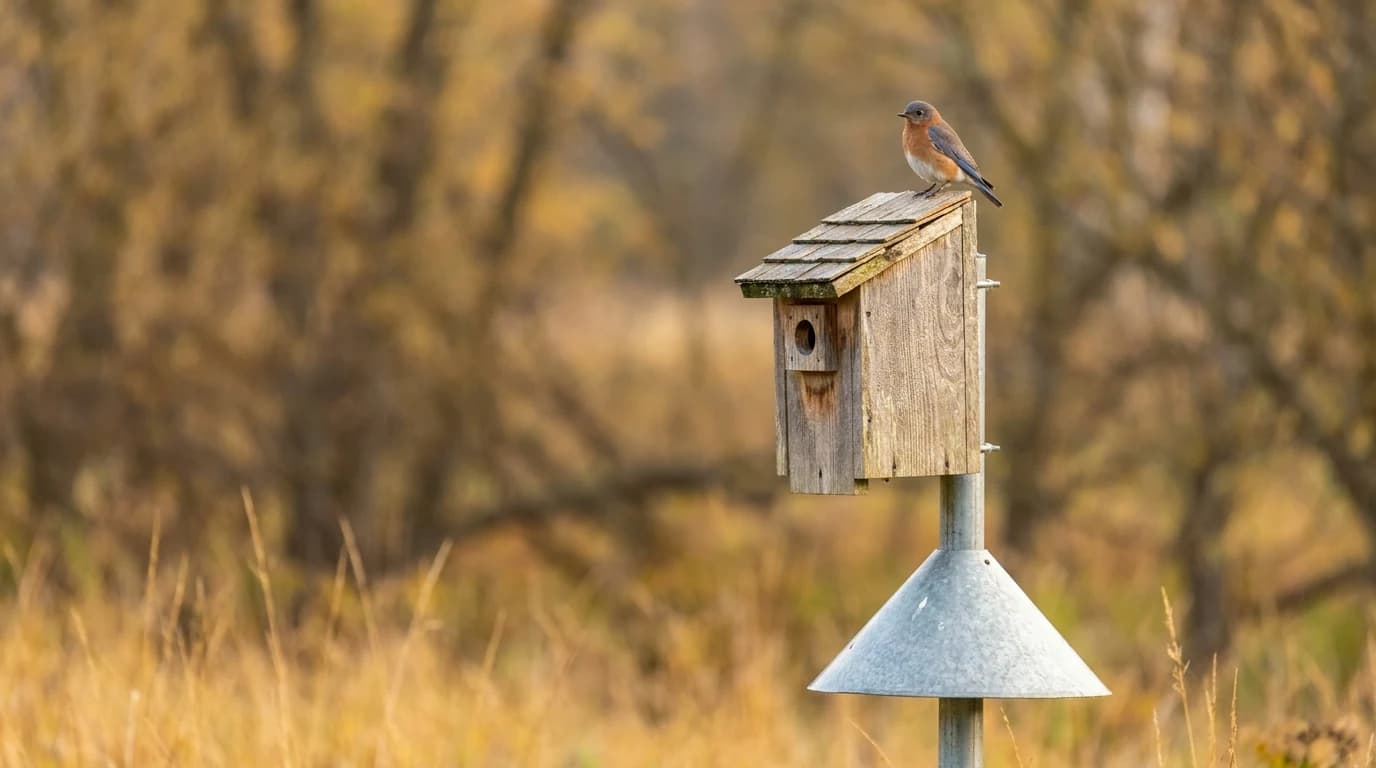
- A tree or fence-post mount. NestWatch prefers a baffled metal pole, because raccoons remember box sites year to year.
Where to mount it
- Use a metal pole. NestWatch calls a free-standing metal or PVC pole the best way to mount small boxes: higher than a fence post, harder to climb, and easy to fit with a guard.
- Add a predator guard. A cone baffle about 3 feet across under the box, a stovepipe baffleA dome or cylinder on a feeder pole that blocks squirrels from climbing up to the seed., or a Noel wire-mesh guard on the entrance.
- Match the habitat. Bluebird boxes go in the open, chickadee and titmouse boxes near mature trees. The vegetation around the box shapes which species moves in.
- Give wrens room. NestWatch advises placing boxes for other species at least 100 feet from wren boxes, since House Wrens may destroy nearby eggs.
- Pair swallows and bluebirds. Two boxes 15 to 25 feet apart let one of each nest.
The baffle logic is the same one that keeps feeders safe from squirrels.
When to put it up, and when to clean it out
| Season | What to do | Source |
|---|---|---|
| Fall | Clean out old nests once there is no sign of activity | NestWatch FAQ |
| Winter | Leave boxes up as roosts, or plug the hole if sparrows move in | NestWatch FAQ; Iowa DNR |
| February | South: boxes in place. Everywhere: repair old ones | NestWatch; Iowa DNR |
| Mid to late March | North: boxes in place | NestWatch |
| Nesting season | Clean between broods once young fledge | Iowa DNR; NestWatch bluebird page |
The NestWatch FAQ says it is perfectly fine to wait until fall to clean a box, as long as nothing is active. Boxes can stay up over winter as roosting spots; some landlords seal them instead. The Iowa DNR bluebird guide suggests plugging the entrance over winter to keep sparrows out, and NestWatch adds that waiting to open boxes until migrants return gives them a better chance at an empty one.
Fall plan: clean now, fix now, open by February in the south or by late March in the north.
If you would rather buy than build
Check the hole against the table before anything else. From our catalog, the Kingsyard wren house lists a 1-inch entrance and a metal predator guard, matching the House Wren spec. The Woodlink wren and chickadee house lists a 1 1/8-inch hole and a side that opens, the chickadee number. The Kettle Moraine bluebird box lists a 1 1/2-inch entrance plus a steel pole kit and baffle; it is recycled plastic rather than the untreated wood NestWatch recommends, so weigh that.
Once a box is up, the rest of the yard matters too: see the broader guide to attracting birds to your yard.
Ready to put up a box?
Frequently asked
What size hole does a bluebird house need?+
NestWatch lists 1 1/2 inches round, or an oval 2 1/4 inches high by 1 3/8 inches wide, for the Eastern Bluebird; Western Bluebirds also use 1 1/2 inches and Mountain Bluebirds 1 9/16. New York DEC's plan says not to change it: 1 1/2 inches is correct for bluebirds on a standard box. If you build the Peterson design, Tennessee's wildlife agency says the oval hole is critical.
Should a birdhouse have a perch?+
No. NestWatch says a perch is unnecessary for the birds and can help predators get into the box, and both New York DEC and Tennessee's wildlife agency say a bluebird box should never have one.
When should I clean out a birdhouse?+
Only when there is no sign of breeding activity. NestWatch says some monitors clean after every brood and that it is perfectly fine to wait until fall. For bluebirds and Tree Swallows, cleaning soon after the young leave frees the box for a second nest or another species.
Can I leave a birdhouse up all winter?+
Yes. NestWatch says boxes can stay up as winter roosts, and it notes Carolina Wrens and White-breasted Nuthatches may roost in them. If House Sparrows are claiming boxes near you, the Iowa DNR suggests plugging the entrance over winter and reopening once migrants return.
How high should a birdhouse be?+
It depends on the species. NestWatch lists 3 to 6 feet for Eastern Bluebirds and Carolina Wrens, 5 to 6 feet for Tree Swallows, 5 to 10 feet for House Wrens and 5 to 15 feet for chickadees and titmice. Height matters less than a smooth metal pole with a baffle beneath the box.
Sources & further reading
We research from primary and authoritative sources. Where our guidance rests on a fact, here's where it comes from.
- Nest Box Placement | NestWatch (Cornell Lab) — Requirements table: hole size, box height, minimum spacing and habitat by species; place boxes by February in the south and mid to late March in the north; metal or PVC poles; pair boxes 15 to 25 feet apart
- Features of a Good Birdhouse | NestWatch (Cornell Lab) — Untreated wood, 3/4-inch walls, four 3/8 to 1/2-inch drainage holes, two 5/8-inch vents per side, 2 to 4-inch roof overhang, no perches, cone/stovepipe/Noel guards; starlings need 1 9/16 inches, House Sparrows 1 1/4 inches
- Managing House Sparrows and European Starlings | NestWatch — Both introduced in the 19th century and not protected by the Migratory Bird Treaty Act; kill nestlings and adults; no completely sparrow-proof box; placement and delayed opening as passive controls
- Frequently Asked Questions | NestWatch — Clean only when there is no breeding activity; fine to wait until fall; boxes can stay up over winter as roosts or be sealed; illegal to disturb native birds' nests or eggs
- House Wren — Right Bird, Right House | NestWatch — 1-inch hole, 5 1/2 x 5 1/2 floor, 8-inch depth; keep other species' boxes 100 feet from wren boxes
- Black-capped Chickadee — Right Bird, Right House | NestWatch — 1 1/8-inch hole, 5 1/2 x 5 1/2 floor, 8-inch depth
- Carolina Chickadee — Right Bird, Right House | NestWatch — 1 1/8-inch hole, 5 1/2 x 5 1/2 floor, 8-inch depth
- Tufted Titmouse — Right Bird, Right House | NestWatch — 1 1/4-inch hole, 5 1/2 x 5 1/2 floor, 8-inch depth
- White-breasted Nuthatch — Right Bird, Right House | NestWatch — 1 1/4-inch hole, 5 1/2 x 5 1/2 floor, 8-inch depth
- Tree Swallow — Right Bird, Right House | NestWatch — 1 3/8-inch hole, 5 1/2 x 5 1/2 floor, 9-inch depth; clean out once young leave
- Eastern Bluebird — Right Bird, Right House | NestWatch — 5 1/2 x 5 1/2 floor, 9-inch depth; lists a 2 1/4-inch entrance (the oval's height); clean out as soon as a brood fledges
- Carolina Wren — Right Bird, Right House | NestWatch — 5 x 6 1/2 floor, 7-inch depth, slot-style pseudocavity; boxes used for winter roosting
- Eastern Bluebird Nest Box | Tennessee Wildlife Resources Agency — Peterson-style box needs an oval hole; never include an under-the-hole perch; mount on conduit, not trees or fence posts
- Eastern Bluebird Nest Box Construction Plan (PDF) | New York State DEC — Do not change the entrance size: 1 1/2 inches is correct for bluebirds; a bluebird box should never have a perch; mount boxes by mid-March
- The Eastern Bluebird (PDF) | Iowa Department of Natural Resources — Repair boxes in February, place new boxes mid-March to early April; clean between broods and at season's end; plug the entrance over winter to keep sparrows out
Prices and BirdingScores reflect our most recent research and refresh on a cycle; confirm the live price before buying. We may earn a commission from affiliate retailers — it never changes our recommendations. See how we review.