
House Finch vs Purple Finch: Check the Odds, Then the Tail
House Finch or Purple Finch? Check this winter's finch forecast first, then the flanks, hindneck and undertail. Marks for males, females and Cassin's.
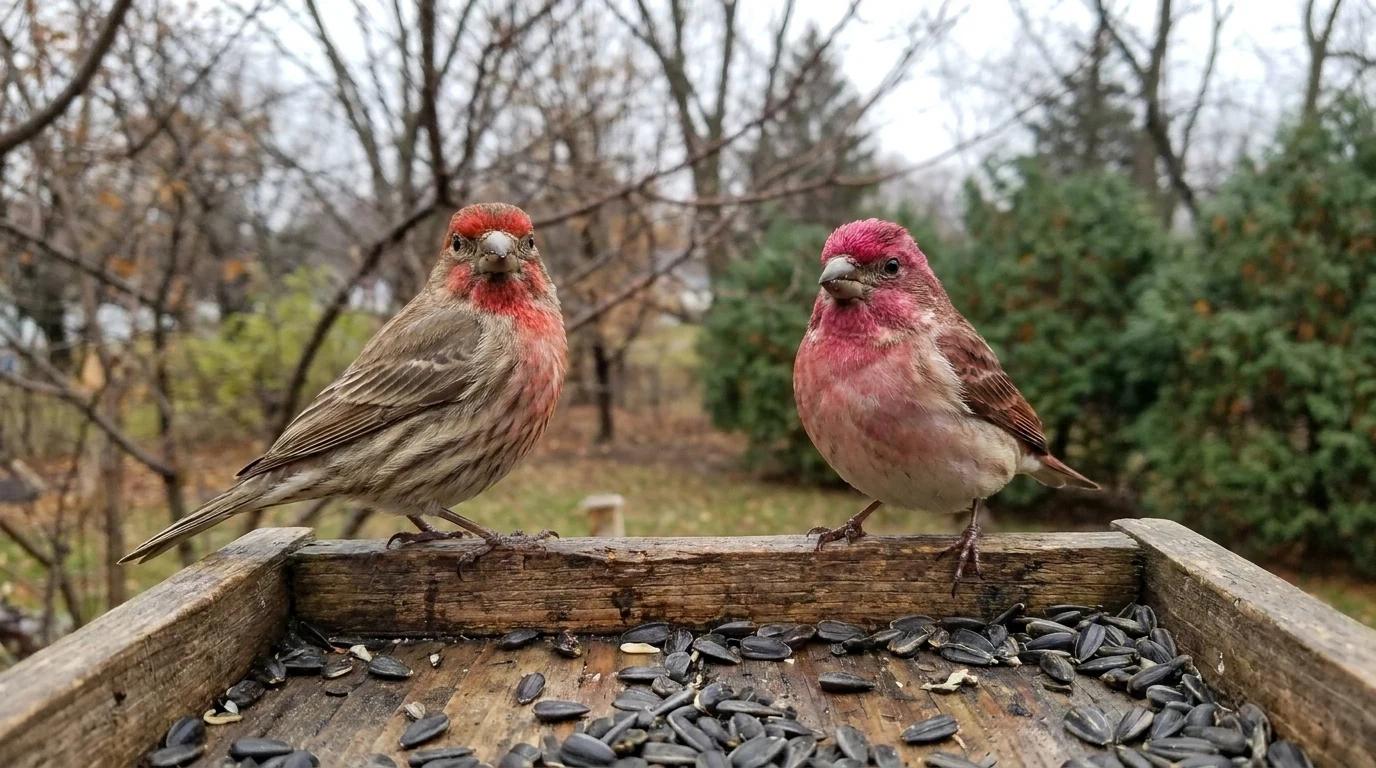
Key takeaways
- Start with the odds. Audubon puts House Finches at about 40 million and Purple Finches at about 6.5 million, so a red finch is usually a House Finch.
- This winter's forecast narrows it further. The Finch Research Network expects Purple Finches in the Northeast and Great Lakes, as good a chance or better in the central US, and a small flight at best farther south.
- The undertail is the clincher. FeederWatch calls a Purple Finch's clean white undertail diagnostic; House Finches show broad dark streaks there.
- Ignore how red the bird is. House Finch color comes from diet, so males range from yellow to deep red.
Pick by your situation
| If your situation is… | Pick | Why |
|---|---|---|
| Red-headed male with heavily streaked sides | House Finch | FeederWatch describes conspicuously streaked sides on male House Finches; Purple Finches are faintly streaked below. |
| Male washed raspberry, color reaching the back of the neck | Purple Finch | FeederWatch notes the raspberry hindneck separates Purple from both House and Cassin's. |
| Brown bird with a bold white eyebrow and dark cheek | Female Purple Finch | Female House Finches have a plain face with no strong pattern. |
| Yellow or orange male at a feeder | House Finch | House Finch color depends on carotenoids in the diet, so yellow males are normal. |
| Peaked red crown in the mountain West | Check for Cassin's Finch | FeederWatch notes all three species can occur in parts of the West. |
A shortcut by situation — start from the row that sounds like you.
A red finch lands on the feeder and the question starts: House Finch or Purple Finch? Most guides go straight to field marks. Start one step earlier. Before you judge the bird, judge the odds, because for most backyards in most winters the odds settle it before the bird turns around.
Step zero: the odds before the bird
Audubon's field guide puts the House Finch population at about 40 million. Its Purple Finch account gives about 6.5 million. That is roughly six House Finches for every Purple Finch across the continent. It is not a feeder count, and your yard may differ, but it is the right starting assumption.
Purple Finches also move around in some winters and stay north in others. So the second input is this winter's forecast. The Finch Research Network published its 2026-2027 eastern forecast in late September and a central and western irruption alert on October 16. Here is what they say about Purple Finch, region by region.
| Where you are | What the forecast says for Purple Finch this winter | What that means at your feeder |
|---|---|---|
| Eastern Canada, Great Lakes, northeastern US | Many will move in to use good spruce, white pine and mountain-ash crops | A real chance, though good crops keep birds in the woods more than at feeders |
| Mid-Atlantic and southern states | If a flight comes at all, a late-developing small one at best | Start from House Finch; a Purple Finch is the exception you confirm |
| Central US (Mississippi to the Rockies) | As good a chance as the East, or better; any irruption likely late November to January | Worth checking every red finch from late November on |
| West | The western Purple Finch is less irruptive; local shifts happen, such as more birds in central Oregon this fall | Your local pattern matters more than a continental forecast |
The useful habit: decide what you expect to see before you look. If the bird matches the expected species, confirm it. If it seems to be the rarer one, ask for a second field mark before you call it.
Three checks, in the order the feeder gives them
A finch on a tube feeder rarely poses in profile. It sits low, faces the port, and shows you its back or belly. Project FeederWatch's three-finch comparison lists every mark you need. Here they are in the order you usually get them.
- The flanks. On a male House Finch, the red chest gives way to conspicuously streaked sides. A male Purple Finch's color fades into a faintly streaked lower breast and belly, and Audubon notes it lacks obvious dark stripes on the sides.
- The back of the head. A male Purple Finch's raspberry color carries onto the hindneck. FeederWatch notes that House and Cassin's Finches do not show this. A male House Finch shows a red headband against a brown cap and a brown cheek patch.
- The undertail. FeederWatch calls a Purple Finch's undertail usually white with no streaks, and diagnostic if you can see it. A House Finch has broad dark streaks there. This works for females too, and a bird leaning into a feeder port often shows it.
Males and females need different checks
Male: check these
- Where the color sits: the whole head and chest (Purple) or forehead, eyebrow and chest (House)
- Whether red reaches the back of the neck (Purple)
- Streaked sides (House) or nearly clean sides (Purple)
Female: check these
- Face pattern: bold white eyebrow, dark cheek and white moustache stripe (Purple), or a plain face (House)
- Underparts: bright white with short, thick streaks (Purple), or dull white with long, thin, smudgy streaks (House)
- Undertail: clean white (Purple) or broadly streaked (House)
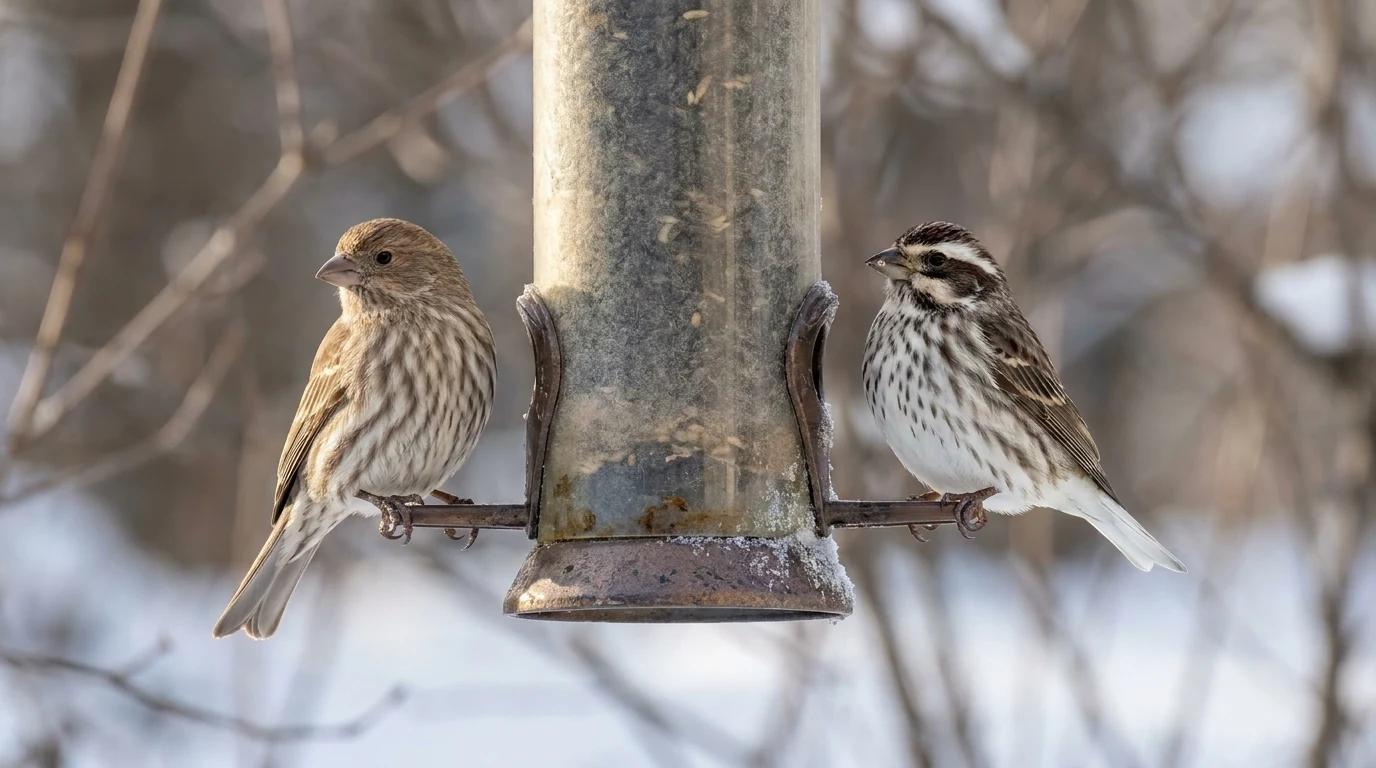
Females are often the easier pair. The female Purple Finch's striped face is one of the boldest marks in this group, and Audubon describes the female House Finch's face as rather plain. If the bird is brown with a strong white eyebrow, it is very unlikely to be a House Finch.
Shape, if the bird sits still
| House Finch | Purple Finch | Cassin's Finch (West) | |
|---|---|---|---|
| Head | Rounded, smooth crown | Fairly large; can look peaked | Large; often a peaked crown |
| Body | Slim | Somewhat plump | Somewhat large, chunky |
| Tail | Somewhat long, slightly notched | Short, deeply notched | Short, deeply notched |
| Bill | Short and stubby, curved top edge | Short and conical (bigger on Pacific birds) | Slightly longer, nearly straight top edge |
| Male color | Yellow to orange to red; richest on forehead and chest | Raspberry over most of the head, back and chest | Bright red crown contrasting with a pinkish face |
Shape and bill details are from FeederWatch's comparison; size ranges overlap (Audubon gives 5½ to 6½ inches for Purple and 5 to 6 inches for House), so judge proportions, not size.
How red the bird is tells you little
A deep red does not make a bird a Purple Finch, and an orange or yellow male is still a House Finch. FeederWatch's color variants page explains that House Finch color comes from carotenoid pigments in the bird's diet during molt. Captive males fed without those pigments grew yellow feathers instead of red. Yellow birds are frequently seen in the Southwest and Hawaii, where natural foods carry fewer of those pigments.
So a yellow-orange finch at your feeder is usually just a House Finch, not a rare bird or a hybrid. Read where the color sits, not how bright it is.
Rule of thumb: where the color sits beats how much color there is.
Why the East has so many House Finches
Until the 1940s, House Finches lived only in western North America. Audubon records that New York pet-shop owners released birds in 1940 to escape prosecution for illegal sales, and the species spread west until it met its western relatives on the Great Plains. Audubon also suggests competition, first with House Sparrows and then with House Finches, may have pushed Purple Finches away from northeastern feeders and back into the woods.
If the bird has crusty eyes
Red, swollen, runny or crusty eyes are a sign of House Finch eye disease, a bacterial conjunctivitis first seen at feeders around Washington, D.C., in January 1994. FeederWatch notes it has since reached Purple Finches, American Goldfinches and Evening Grosbeaks, so a sick bird's species does not change what you should do. FeederWatch's advice is to take feeders down, clean them with a 10% bleach solution, let them dry completely, and rake up old seed and droppings underneath. Our feeder cleaning guide walks through it. Don't add medication to seed or water; FeederWatch says not to under any circumstances.
When it still won't resolve
- Take a photo of the bird from below. The undertail and flanks decide more cases than any other angle.
- Listen. Audubon describes the House Finch's song as warbling notes ending in a buzzy "zeee," and the Purple Finch's flight call as a distinctive tick. Our Merlin guide covers recording a call.
- Log it honestly. "Finch sp." is a fine eBird entry. The Finch Research Network asks for western Purple Finch sightings to map local movements, so a careful report is more useful than a confident guess.
Both species eat black oil sunflower readily; our sunflower seed guide covers which kind to buy. For the other regulars, use our backyard bird identification guide.
Useful gear for this guide
Optional, subject-matched picks from our live catalog—not a requirement for doing the advice above.
Next: put names to the rest of your winter feeder regulars.
Frequently asked
How can you tell a House Finch from a Purple Finch?+
Look at the flanks and undertail. Male House Finches have streaked sides and a streaked undertail; male Purple Finches look dipped in raspberry, with faint streaks below and a white undertail. Females are easier: a female Purple Finch has a bold white eyebrow and dark cheek, while a female House Finch has a plain face.
Are Purple Finches rarer than House Finches?+
Yes, overall. Audubon's field guide gives a population of about 6.5 million Purple Finches against about 40 million House Finches. Purple Finches also move south in some winters and stay north in others, so their numbers at feeders vary by year.
Will Purple Finches come south this winter?+
The Finch Research Network's 2026-2027 forecast expects many in eastern Canada, the Great Lakes and the northeastern US, a central-US flight as likely or likelier than an eastern one, and at best a late, small flight to the Mid-Atlantic and southern states.
Why is my House Finch yellow or orange?+
Diet. Project FeederWatch explains that House Finch red comes from carotenoid pigments eaten during molt, and yellow birds are seen frequently in the Southwest and Hawaii. It is the same species, not a rarity.
What should I do if a finch at my feeder has crusty eyes?+
Project FeederWatch advises taking feeders down, cleaning them with a 10% bleach solution, letting them dry completely, and raking up old seed and droppings. Do not add medication to seed or water.
Sources & further reading
We research from primary and authoritative sources. Where our guidance rests on a fact, here's where it comes from.
- Project FeederWatch: Tricky Bird ID, Cassin's Finch, House Finch and Purple Finch — Shape, bill, male color, female face pattern, underparts and the diagnostic white Purple Finch undertail; all three can occur in parts of the West.
- Audubon Guide to North American Birds: House Finch — Population about 40 million, 5-6 in, plain female face, song ending in a buzzy zeee, and the 1940 New York release.
- Audubon Guide to North American Birds: Purple Finch — Population about 6.5 million, 5.5-6.5 in, male lacks obvious side stripes, female's whitish eyebrow, flight call, and the northeastern feeder decline.
- Finch Research Network: Winter Finch Forecast 2026-2027 — Tyler Hoar's eastern forecast: Purple Finches into eastern Canada, the Great Lakes and the Northeast; at best a late, small flight farther south.
- Finch Research Network: Irruption Alert 2026-2027, central and western areas — October 16 alert: central-region chances as good or better than the East; western Purple Finch less irruptive; request for eBird reports.
- Project FeederWatch: Unusual Birds, color variants — Diet-related carotenoid color in House Finches; yellow birds frequent in the Southwest and Hawaii.
- Project FeederWatch: House Finch Eye Disease — Mycoplasmal conjunctivitis since 1994, spread to Purple Finch and other species, and the 10% bleach feeder-cleaning advice.
Prices and BirdingScores reflect our most recent research and refresh on a cycle; confirm the live price before buying. We may earn a commission from affiliate retailers — it never changes our recommendations. See how we review.