
Confusing Fall Warblers: Read the Underside First
Field guides draw warblers in profile; the canopy shows you the underside. A five-species key read from below, plus the two pairs that are genuinely hard.
Key takeaways
- Identify from below, because that is the view you get. Cornell's own Bay-breasted Warbler page tells birders to look at the bird from underneath and read the flanks and undertail coverts.
- Undertail coverts settle the hardest pair. Tennessee's are white even on an otherwise olive-yellow bird; Orange-crowned's are yellow in every plumage and region, often the brightest part of the bird.
- Leg colour settles the other one. Blackpoll has orange-yellow legs; Bay-breasted's are dark and lack the contrasting pale soles.
- "Confusing fall warblers" was a caption, not a verdict. The Toledo Museum of Art holds Roger Tory Peterson's 1960 plate of that exact title — one page of birds, not an indictment of the family.
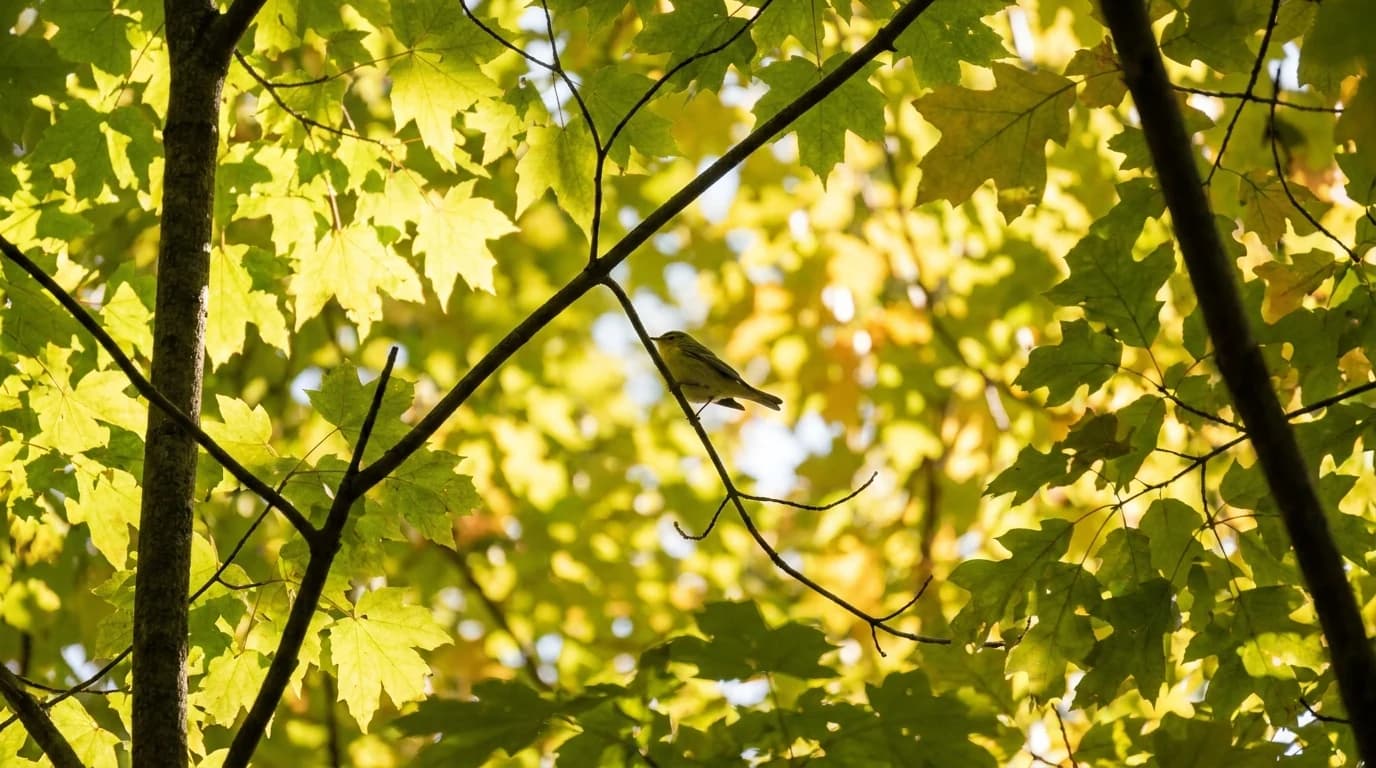
You almost never see a fall warbler the way the book draws it. The plate shows a bird in clean profile, side-lit, perched on a bare twig at eye level. Late August hands you something else: a small shape forty feet up, moving fast through backlit leaves, with the only part of it facing you being the underside.
That mismatch — more than the drab plumage — is what makes fall warblers feel impossible. Fix the viewing angle and a surprising number of them collapse into a short list of answers.
The phrase came from a single plate
"Confusing fall warblers" was never a diagnosis. It was a caption. The Toledo Museum of Art holds the original artwork under exactly that title: a 1960 board in gouache, watercolour, pencil and ink by Roger Tory Peterson, painted as plate 10 of his 1960 guide to the birds of Texas and adjacent states.
One plate. A bounded group of birds that needed to share a page because they looked alike on paper. Generations of birders inherited it as a mood instead — and a mood is much harder to work through than a plate.
The reframe: you are not learning "fall warblers." You are learning the six or eight species passing through your patch this month, from underneath.
Read the underside first
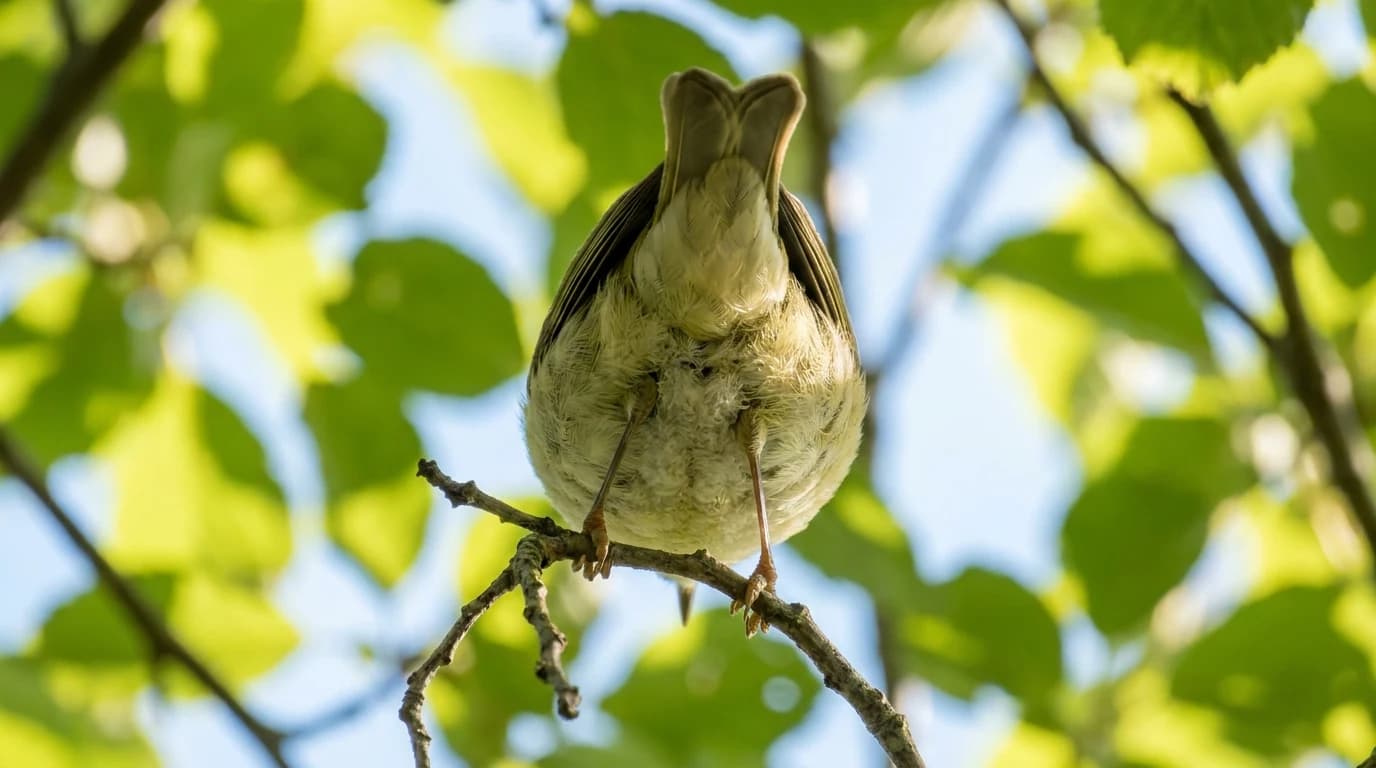
This is not a workaround for bad views. It is what the Cornell Lab itself tells you to do. One caption on the Bay-breasted Warbler identification page instructs birders outright: when viewed from below, look for plain, unstreaked yellow-green plumage with buff-olive tones on the flanks and undertail coverts.
The undertail coverts — the block of feathers between the legs and the tail tip — are the most useful patch on a canopy warbler for one unglamorous reason. They are the patch aimed at you.
| Species | Undertail coverts & flanks | Legs and feet | The other tell |
|---|---|---|---|
| Tennessee | White undertail coverts, even on birds that are olive-yellow everywhere else | Dark | No distinct wingbars; thin, sharply pointed bill |
| Orange-crowned | Yellow undertail coverts — always, and often the brightest part of the bird | Dark | Faint eyeline, broken eyering, no bold wingbars |
| Blackpoll | Whitish below with blurry streaking along the flanks | Orange-yellow, sometimes startlingly bright | Bold white wingbars; dark eyeline on a pale yellow face |
| Bay-breasted | Plain buff-olive flanks and undertail coverts, unstreaked | Dark, with no contrasting pale soles | Bold white wingbars; plain, low-contrast face |
| Pine | White lower belly and undertail coverts, blurry side streaks | Dark | Big and long-tailed, stout bill, "spectacled" broken eyering |
Every row above is straight off that species' Cornell Lab identification page — the Blackpoll, Tennessee, Orange-crowned and Pine entries, plus Bay-breasted above.
Check things in this order
The order matters more than the list, because you rarely get all five before the bird moves.
- Undertail coverts. White, yellow, or buff-olive? This alone splits the two hardest pairs.
- Legs and feet. Pale or dark. A two-state question, answerable in a glance from below.
- Wingbars. Bold and white, faint, or absent.
- Flank streaking. Crisp, blurry, or none at all.
- Structure. Tail length, bill thickness, how heavy the bird looks.
Notice what is missing: the colour of the back, the pattern on the crown, the exact shade of green. Those are the marks a plate leads with — and the ones a canopy view almost never gives you.
The two pairs that are actually hard
Most fall warblers are not ambiguous. Two pairs genuinely are, and both are settled from below.
- Blackpoll vs. Bay-breasted. Look at the legs, absurd as that sounds. Cornell describes Blackpoll's as orangish; on Bay-breasted they are "nondescript and dark, lacking strongly contrasting yellow soles to the feet." Back it up with the flanks: blurry streaking on a Blackpoll, plain buff-olive on a Bay-breasted.
- Tennessee vs. Orange-crowned. Look at the undertail coverts. Tennessee's are white — Cornell notes that a bird can be very olive-yellow all over except for white undertail coverts. Orange-crowned's are yellow in every region and every plumage, frequently the brightest thing on the bird.
And one ringer worth knowing before it wastes your morning: a Pine Warbler offers white undertail coverts, blurry side streaks and bold wingbars — a passable Blackpoll impression. It is a bigger, longer-tailed, stouter-billed bird with a pale broken eyering and dark legs.
When to stop looking
Cornell says of nonbreeding Bay-breasteds, in plain language, that they can be hard to identify. That is the Lab conceding the point, and it is worth more than any blog promising you a system.
The honest ceiling: first-fall birds are variable, views are short, and some individuals cannot be identified from what you saw. "Warbler sp." is a real entry in eBird, not a failure — and an unresolved bird you looked at properly teaches you more than a confident wrong name.
A paper field guide earns its keep here in a way an app does not, because it prints the undersides side by side on one page for comparison. Peterson's own descendants are still in print — the modern Peterson Field Guide to Birds of North America traces directly back to the plate that started this (see it on Amazon). The rest of the shelf is in our field guide picks.
Practise before the wave arrives
Fall warbler passage runs for weeks, so the skill has time to build. Give it three sessions rather than one:
- Pick six. Pull the warblers actually reported in your county this month rather than studying all fifty.
- Study only the undersides. Cover the top half of each plate with your thumb.
- Rehearse the two-state questions. Pale legs or dark. White coverts, yellow, or buff.
- Bird the edges, not the canopy. Creek corridors and woodland edges put birds closer to eye level, where a first look is easier — see our guide to fall migration in August and September for the timing.
You will still lose birds. But the ones you lose will be the genuinely hard ones, which is a different and much better problem than losing all of them.
Next: the timing behind the birds you are trying to name.
Frequently asked
Why are fall warblers so much harder than spring warblers?+
Three things stack up at once. Most birds have moulted out of bright breeding plumage, a large share of the birds moving through are first-fall juveniles you have never seen before, and almost nobody is singing, so the sound shortcut is gone. On top of that the viewing angle changes: spring birds feed in bare or barely-leafed branches, while fall birds work full canopy, so you see the underside rather than the profile a field guide draws.
What are undertail coverts, and why do birders keep pointing at them?+
They are the block of small feathers between the legs and the base of the tail, on the bird's underside. They matter in fall for a practical reason rather than a scientific one — they are the part of a canopy bird aimed straight at you, and their colour is stable across plumages. The Cornell Lab uses them as a primary mark for several fall warblers: white on Tennessee, yellow on Orange-crowned, buff-olive on Bay-breasted.
How do I tell a Blackpoll from a Bay-breasted Warbler in fall?+
Start with the legs and feet. The Cornell Lab describes Blackpoll's as orangish, bright enough to notice, while Bay-breasted's are dark and nondescript with no contrasting yellow soles. Confirm with the flanks: a fall Blackpoll shows blurry streaking on whitish underparts, and a fall Bay-breasted shows plain, unstreaked buff-olive flanks and undertail coverts along with a low-contrast, plain face.
Is it okay to give up on a warbler I cannot name?+
Yes, and it is better practice than guessing. The Cornell Lab says outright that nonbreeding Bay-breasted Warblers can be hard to identify, so an unresolved bird puts you in good company. Log it as "warbler sp." in eBird — that is a legitimate entry that keeps your checklist honest and still contributes the effort data researchers use.
Sources & further reading
We research from primary and authoritative sources. Where our guidance rests on a fact, here's where it comes from.
- Bay-breasted Warbler Identification — All About Birds, Cornell Lab of Ornithology — Source of the "when viewed from below" instruction, the buff-olive undertail coverts and flanks, the dark legs lacking pale soles, and the note that nonbreeding birds can be hard to identify.
- Blackpoll Warbler Identification — All About Birds, Cornell Lab of Ornithology — Orange-yellow legs in all plumages; nonbreeding birds washed pale yellow with blurry flank streaking and bold white wingbars.
- Tennessee Warbler Identification — All About Birds, Cornell Lab of Ornithology — White undertail coverts even on birds that are olive-yellow overall, plus the lack of distinct wingbars and the thin, pointed bill.
- Orange-crowned Warbler Identification — All About Birds, Cornell Lab of Ornithology — Undertail coverts are always yellow and are often the brightest part of the plumage, across regional variation.
- Pine Warbler Identification — All About Birds, Cornell Lab of Ornithology — White lower belly and undertail coverts, blurry side streaking, stout bill, long tail and the broken "spectacled" eyering.
- Roger Tory Peterson, "Confusing Fall Warblers" (1960) — Toledo Museum of Art — Museum record for the original plate 10 artwork that gave the phrase its name: gouache, watercolour, pencil and ink on board, object 2012.121.
Prices and BirdingScores reflect our most recent research and refresh on a cycle; confirm the live price before buying. We may earn a commission from affiliate retailers — it never changes our recommendations. See how we review.