
Dark-eyed Junco: Identify and Feed Your Winter Visitors
Identify Dark-eyed Juncos by bill and tail, compare six regional forms, and choose seed, trays and winter water that suit these ground-feeding birds.
Key takeaways
- Look for the pale bill and white tail edges before deciding which regional form you have.
- Low, clean feeding surfaces matter more than adding another hanging feeder.
- Choose one seed option; open water is a separate winter task.
What to put out for juncos
Start with food placement, not a new feeder. Cornell's junco life history says these seed-eating sparrows appear to prefer millet to sunflower at feeders. A low, washable tray lets you offer it without turning the lawn into a seed pile. Keep the other feeders you already own; this is an extra feeding lane for the birds below them.
These are researched catalog options, not products tested in our yard. You need one seed option, not all three; water is a separate job.
| Product | Best for | The useful spec | Trade-off |
|---|---|---|---|
| Lyric Fine Tunes | A millet-containing, shell-free starting mix | Hulled white proso millet with finely cut kernels and nuts | Edible ingredients can still be left uneaten |
| Wagner's Greatest Variety Blend | A shared feeding area for several species | White millet in a mixed-seed blend | Shells and rejected seed need clearing |
| Kaytee Ultimate No Mess | Less hull debris on a patio | Hulled sunflower and peanuts | Not a millet-first mix; dropped food still needs cleanup |
| API Four Seasons heated bird bath | Open water in freezing weather | Heated bowl with deck and pole mounts | Needs power and regular water care; it is not a feeder |
Ingredients and mounting details are from the linked product records and current listing descriptions. For the wider food choices, see our sunflower, nyjer and suet guide. A bag's “no waste” wording describes ingredients, not a promise that every bird will eat every piece.
The useful change: offer the seed where a junco can stand and peck. Buying more seed won't fix a feeding spot it rarely uses.
Identify the little birds beneath the feeder
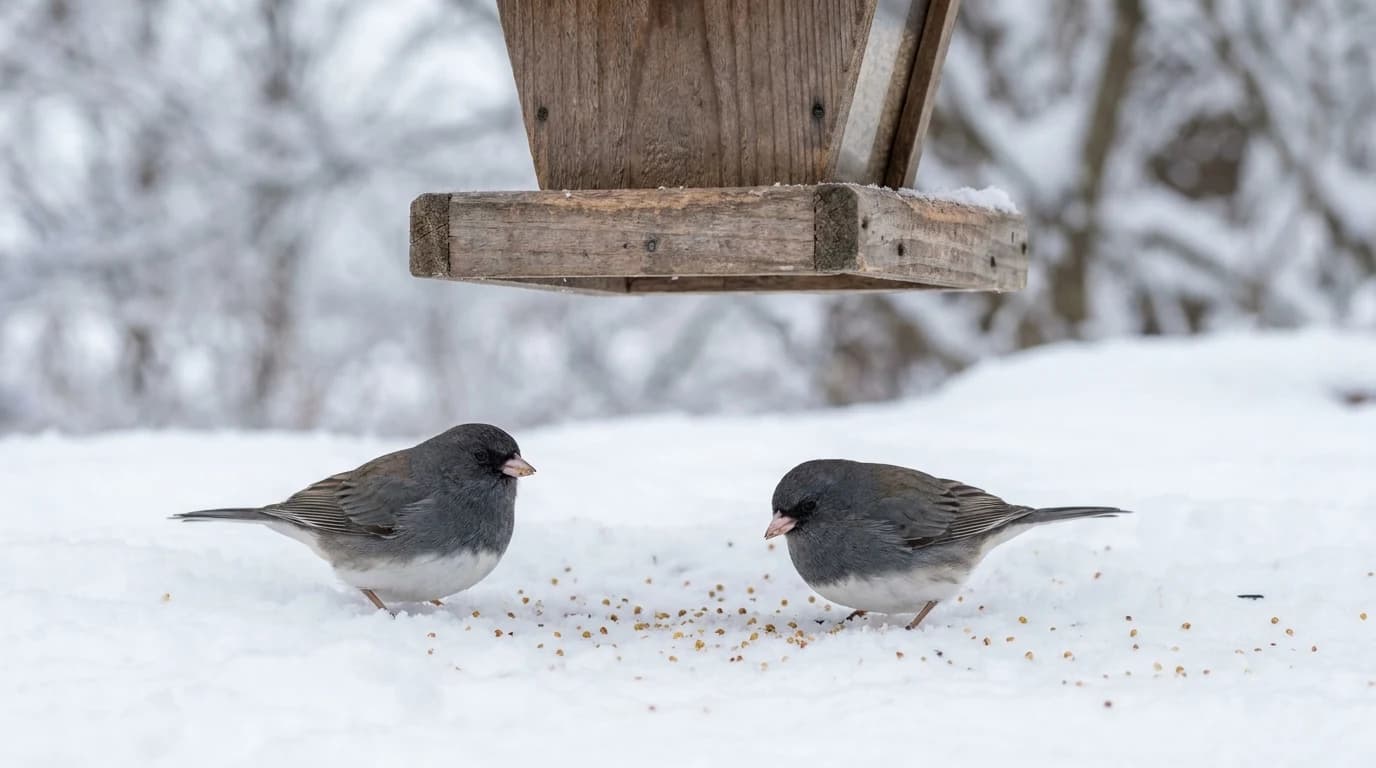
A Dark-eyed Junco has a small pale bill, a dark gray or brown upper body, a light belly and white outer tail feathers that flash as it flies. Watch the tail when the flock lifts: those white edges are often easier to catch than the belly while a bird is crouched over seed.
- Shape: rounded head, short seed-cracking bill, fairly long tail.
- Action: hopping and pecking near the ground, then a quick flight into cover.
- Color: a clean-looking adult can be gray, hooded or brown-sided; young birds may be streaky.
Don't reject a brown bird because the first photo you saw was slate gray. Compare it with the sparrows in our common backyard bird identification guide, then use several field marks together.
Six forms, one species
Cornell's regional guide separates six readily recognized forms. These are broad regional associations, not exclusive winter boundaries.
| Form | Main clue | Broad regional association |
|---|---|---|
| Slate-colored | Gray above, white belly | Eastern U.S. and much of Canada |
| Oregon | Dark hood, brown back, warm sides | Much of the western U.S. |
| Pink-sided | Gray head, broad pinkish-brown sides | Rockies and western Great Plains |
| White-winged | Pale gray, faint white wingbars | Rockies and western Great Plains |
| Gray-headed | Gray head, rusty back, pale bill | Southwest |
| Red-backed | Rusty back, dark face, darker upper bill | Southwest |
Audubon's species guide notes that different forms can share a winter flock in the West. Treat location as a clue, not a verdict. If a bird is ambiguous, recording “Dark-eyed Junco” is useful; you don't have to force a form name.
Match the feeding station to the bird
This is the difference between a junco-friendly yard and a feeder that happens to spill food. The design guidance comes from Project FeederWatch's feeder types; the priorities below apply that guidance to a ground-foraging junco.
| Setup | Junco fit | What to change |
|---|---|---|
| Seed scattered on ground | Matches natural foraging | Offer little at a time; remove leftovers |
| Low platform or tray | Strong fit: FeederWatch specifically names juncos | Choose drainage and easy washing; a roof helps keep seed dry |
| Hopper with an accessible tray | Possible shared feeding station | Make sure the landing area is usable; don't rely on wet spills underneath |
| Narrow-perch tube | Useful for other small birds, not the first junco change | Add a low feeding surface rather than replacing the tube |
| Suet cage | An additional food station, not the millet setup | Keep seed available separately |
| Heated water | A winter water option, not a food delivery method | Use only where freezing makes open water difficult |
A tray's value is access, not height alone. If it holds a puddle, has frozen food stuck to it, or is difficult to wash, lowering it doesn't solve the problem. The FeederWatch feeding guide recommends a quiet spot near natural cover; evergreens also buffer winter wind. See where to place a bird feeder before choosing the easiest window view.
Watch before changing: a flock feeding happily beneath an existing feeder may need a cleaner feeding surface, not another hanging feeder.
Keep the ground crew's food clean
Juncos forage where discarded food and droppings land. That makes the patch below the feeder part of your routine, not an invisible waste bin.
FeederWatch's care advice calls for cleaning seed feeders every week or two, more often in wet weather or heavy use. It also advises replacing bath water every few days and keeping feeding areas free of accumulated debris.
- Inspect before refilling. Remove wet or spoiled food rather than covering it with fresh seed.
- Clear the feeding patch. Pick up hulls and leftovers; keep a tray clean enough to inspect easily.
- Wash, rinse, dry. Take the feeder apart, remove debris, wash with warm water and dish soap, rinse thoroughly and dry before refilling.
- Check the water separately. A heater prevents ice; it doesn't clean a bath. Never use antifreeze.
When snow buries the feeding spot, clear access to the tray and offer fresh food there. Don't dump a larger pile into the snow and assume the flock will recover it all.
When your winter visitors arrive and leave
There isn't one national junco arrival date. Audubon describes most populations as migratory, with some southwestern mountain and southern Pacific Coast populations resident. A winter-only visitor in one yard can therefore be a year-round neighbor in another.
Use your own area as the calendar
- Open a local seasonal bar chart using our eBird guide.
- Compare the junco's fall increase and spring decline with recent nearby sightings.
- Note your own first arrival, largest flock and last spring sighting.
Keep watching the same feeding patch as the season changes. Count birds you can see together rather than adding every visit as a new individual. Your notes turn an anonymous group under the feeder into a flock you recognize—and a better reason to look out the window tomorrow.
Build a cleaner feeding station for your winter visitors.
Frequently asked
What do Dark-eyed Juncos eat?+
They primarily eat seeds. Cornell notes that they appear to prefer millet to sunflower at feeders; they also eat insects during the breeding season.
Do juncos use hanging feeders?+
They can visit feeders, but ground feeding and low platforms are the better starting point. Watch the landing surface and food access rather than assuming every feeder design works equally well.
Are all gray-and-white winter birds juncos?+
No. Combine the pale, short bill, white outer tail feathers, shape and behavior. Females and regional forms can look browner than the familiar slate-gray male.
Sources & further reading
We research from primary and authoritative sources. Where our guidance rests on a fact, here's where it comes from.
- Cornell Lab: Dark-eyed Junco identification — Field marks and broad regional forms.
- Cornell Lab: Dark-eyed Junco life history — Seed preferences and ground-foraging behavior.
- Audubon: Dark-eyed Junco field guide — Mixed winter flocks and resident versus migratory populations.
- Project FeederWatch: feeder types — Low platforms, drainage and feeder-design guidance.
- Project FeederWatch: feeding birds — Cleaning, water and placement guidance.
Prices and BirdingScores reflect our most recent research and refresh on a cycle; confirm the live price before buying. We may earn a commission from affiliate retailers — it never changes our recommendations. See how we review.