
How to Plan Your First Hawk Watch: Day, Wind, Site
At a hawk watch the date matters more than the place. Ninety years of counts from one ridge show where the big days fall, and how to pick yours.
Key takeaways
- Pick the day before you pick the site. Hawk Mountain's biggest Broad-winged Hawk day on record, 11,349 birds, out-counted its average total for an entire season.
- The record days cluster. Its three largest Broad-wing flights all landed between 14 and 18 September; Sharp-shinneds peak in October and Golden Eagles in November.
- Northwest wind, a day or two after a cold front. That is the pattern Hawk Mountain's own site profile names, and it matters more than which lookout you stand on.
- Use the Migration Timing tab on HawkCount. It gives you average weekly counts by species for your nearest site — the single most useful screen in hawkwatching, and almost nobody mentions it.
Most first-timers pick a hawk watch the way you pick a restaurant: find the famous one, drive there, hope. Then they stand on a ridge for four hours and count eleven birds.
The site was fine. The date was wrong. Raptor migration is more concentrated in time than almost anything a beginner can go and watch — and the record of that concentration is public, free, and about ninety years deep.
A hawk watch is a spot somebody already found for you
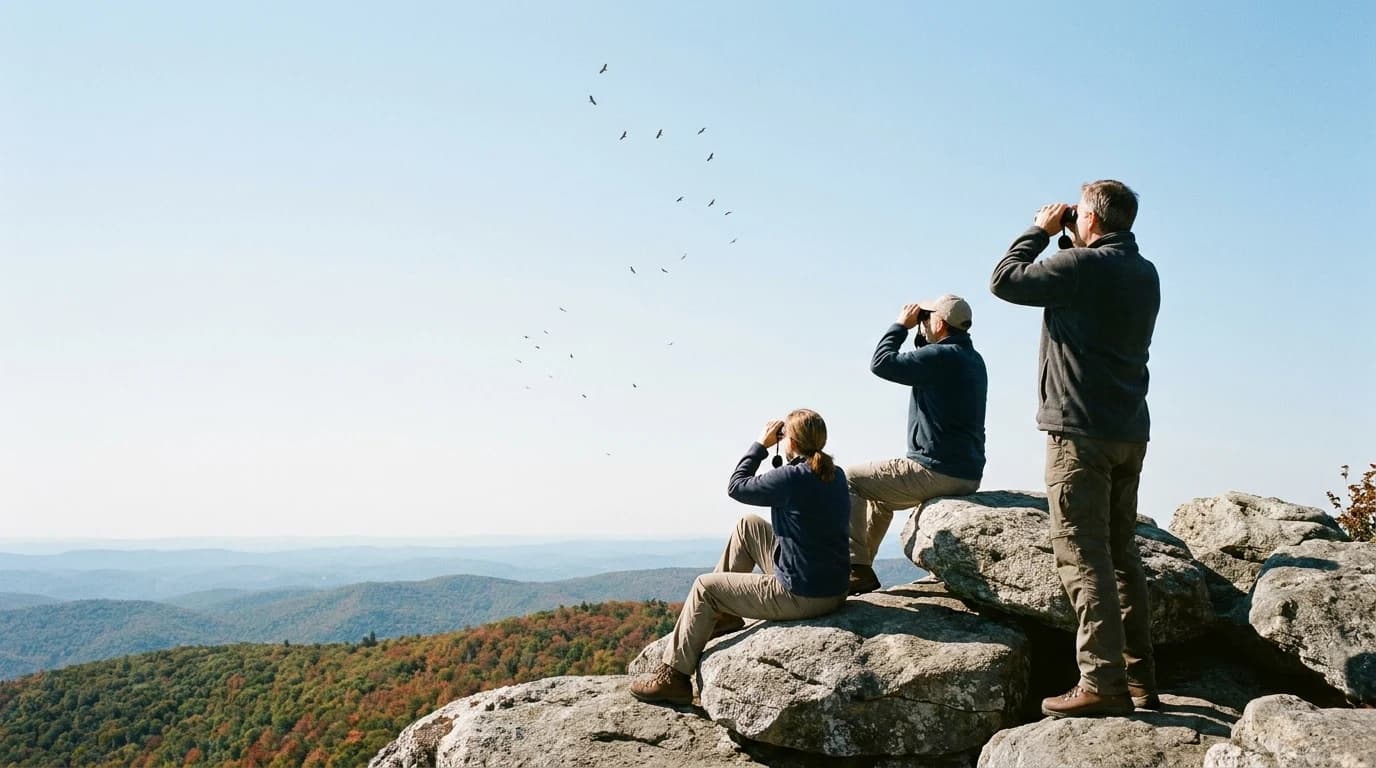
Migrating raptors avoid flapping. They ride thermals — columns of rising warm air — to gain height, then glide down from it, which is why ridges, coastlines and lake shores act as funnels. The same geography works every autumn, so the birds pass the same handful of points year after year. Somebody noticed, sat down, and started counting.
HawkCount, run by the Hawk Migration Association of North America, holds count data and site profiles for over 300 North American hawkwatch sites, searchable by state or province. Most are free, and on good days they are staffed by volunteers who will happily tell you what is moving. Some are not free — Hawk Mountain Sanctuary in Pennsylvania, the oldest of them, charges admission to reach its lookouts.
Why a stranger's favourite rock is also yours: thermals and ridge lift do the flying, so the birds follow terrain instead of a straight line. Terrain does not move between seasons.
The date decides what you see
Hawk Mountain's HawkCount profile carries ninety years of counts across 10,261 days of data — the closest thing North American birding has to a long-run record of what turns up when.
The headline number is hard to argue with. That site averages 8,099 Broad-winged Hawks across an entire season, and its biggest single day on record is 11,349 birds, on 16 September 1948. One day out-counted an average whole season. Its next two biggest Broad-wing days, 14 and 18 September 1978, land inside the same five-day window.
Broad-wings are why mid-September is the famous week. The Cornell Lab describes their kettles as swirling flocks that can hold thousands of circling birds, and four satellite-tracked individuals averaged 4,350 miles to northern South America, covering 69 miles a day.
| Species | Average season count | Biggest single day on record | Date of that day |
|---|---|---|---|
| Broad-winged Hawk | 8,099 | 11,349 | 16 Sep 1948 |
| Sharp-shinned Hawk | 4,240 | 2,475 | 8 Oct 1979 |
| Red-tailed Hawk | 2,979 | 985 | 31 Oct 1937 |
| Osprey | 416 | 187 | 18 Sep 2004 |
| American Kestrel | 392 | 168 | 3 Sep 1977 |
| Golden Eagle | 73 | 48 | 3 Nov 2012 |
Now ignore the counts and read the date column downward: early September, mid-September, early October, late October, November. That is a calendar. Go in mid-September for the Broad-wing spectacle, October for accipiters, November for eagles — and expect a November trip to hand you fewer birds and better ones.
The caveat that comes with it
These are records, from one ridge in eastern Pennsylvania. Your latitude shifts every date, and a record day is a record, not a forecast. What survives the move is the order: buteos in bulk first, accipiters next, the big heavy birds last.
Wind and fronts: the go or no-go call
Two ingredients decide a hawk-watching day, and neither of them is the site. Hawk Mountain's own site profile names both: migration there is most pronounced on northwest winds, especially on the several days following the passage of a cold front.
The go signal, in one line: a northwest wind, a day or two after a front has cleared through.
A northwest wind pushes birds up against the ridge, where they get free lift and travel low enough to identify. A front stacks up birds that have been sitting still, then releases them all at once. HawkWatch International's beginner guidance is the same idea from the other end: rain is bad, but the hours right before or after bad weather are usually excellent.
Worth the drive:
- A cold front cleared through yesterday or the day before.
- Wind out of the north or northwest, with some strength in it.
- Clear or part-cloudy — a few clouds give distant specks something to be seen against.
- Mid-September, if Broad-wings are what you came for.
Save the drive:
- Dead calm and hazy. Birds climb high and effectively vanish.
- Steady rain, or fog sitting on the ridge.
- A south wind for the third day running.
- Arriving at 8am and leaving at 10. Thermals need the morning to build, and hawkwatching is a long game.
The tab nobody points you to
HawkCount's site pages carry four tabs and the useful one is easy to walk past. HawkWatch International tells visitors outright: to find peak migration for the species you care about, open the Migration Timing tab for the hawkwatch you plan to visit.
- Open HawkCount's site finder and pick your state or province.
- Choose the nearest site that has recent data.
- Click Migration Timing. You get every species recorded there, its average and record counts, and a small graph of average weekly totals through the season.
- Find the week where your target species' bar is tallest. That is your trip.
Then, in the week before you go, read the site's own daily log. Hawk Mountain publishes its count every day alongside the day's weather, wind direction and a paragraph of notes — which is how you learn whether this season is running early, late, or is already finished.
Bring less than you think
- The binoculars you already own. This is one of the few birding situations where 10x earns its keep over 8x, because the birds are distant specks rather than warblers in a hedge — our 8x42 vs 10x42 comparison makes that case in full.
- Something to sit on. You will be there for hours with your head tipped back.
- A binocular harness. Hours of head-up watching is the one thing the strap in the box is worst at, and birders recurrently describe swapping it as the cheapest real upgrade in birding — the OP/TECH Bino/Cam harness (on Amazon) is our top-scored one.
- Wind layers, a hat, sunscreen, water. Ridgetops are colder and brighter than the car park you left.
- A spotting scope only if you already own one. Useful on a perched bird or a far-off kettle, useless on anything crossing fast overhead.
- ID help built for silhouettes. A standard field guide is the wrong shape of tool here: it shows perched birds in good light, and you will be looking at a dark cross against a bright sky. HawkWatch International's free raptor ID resources are the no-cost place to start.
Where the forecast runs out
This is the honest gap, and it is a wide one.
- There is no BirdCast for hawks. The radar products birders reach for in autumn model nocturnal migration. Raptors travel by day, so the BirdCast dashboard that tells you tonight will be enormous says nothing about tomorrow's ridge.
- Records are not predictions. Two of Hawk Mountain's three biggest Broad-wing days fell in 1978 and one in 1948. They mark where the window sits. They promise nothing about this September.
- A count is a count, not a census. It records what passed one lookout while somebody was watching, in whatever visibility the day allowed.
So the tools you actually have are a long-run timing table, an ordinary weather forecast, and yesterday's count from the site itself. That combination beats guessing by a wide margin, and it is roughly what the regulars on the rock are using too.
Then write down what you get. A handful of eBird checklists across one autumn is how the pattern for your own region stops being somebody else's table. For everything else moving overhead while you wait, our guide to August and September migration covers the rest of the sky.
A ridge watch is where reach starts to matter.
Frequently asked
When is the best time to go hawk watching?+
It depends on the species and your latitude, but the pattern from Hawk Mountain's ninety-year record is a useful spine: Broad-winged Hawks peak in mid-September, Sharp-shinned Hawks in early to mid-October, Red-tailed Hawks from late October, and Golden Eagles in November. Check the Migration Timing tab for your nearest site on HawkCount rather than trusting a national average.
What weather makes a good hawk-watching day?+
Hawk Mountain's site profile says migration there is most pronounced on northwest winds, especially in the several days following the passage of a cold front. HawkWatch International adds that rainy days are poor but the period right before or after bad weather is usually very good. Dead-calm hazy days are the ones to skip, because the birds climb out of sight.
How do I find a hawk watch near me?+
Use HawkCount's site finder, run by the Hawk Migration Association of North America. It lists more than 300 hawkwatch sites across North America, searchable by state or province, with a profile, map and count history for each one. Pick a site with recent data, because some listed sites are no longer actively counted.
What is a kettle?+
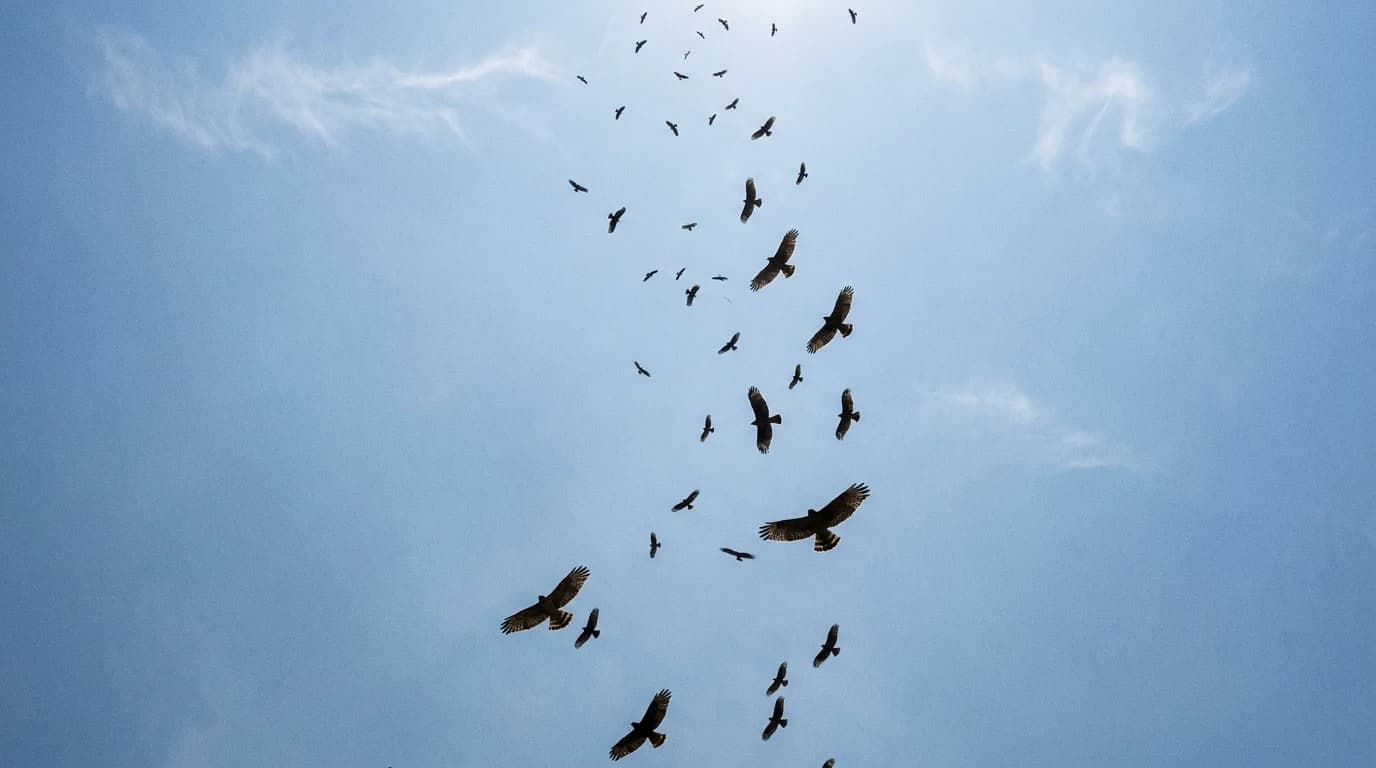
A kettle is a flock of raptors circling together inside a single thermal to gain height before gliding onward. The Cornell Lab describes Broad-winged Hawk kettles as swirling flocks that can contain thousands of circling birds. Seeing one is the reason mid-September draws crowds to eastern ridges.
Do I need a spotting scope for hawk watching?+
No. Binoculars are the primary tool, and a scope is a nice-to-have rather than a requirement. It helps on a perched bird or a distant kettle that is holding position, but it is hard to use on a raptor crossing quickly overhead. Bring one if you already own one; do not buy one for a first trip.
Sources & further reading
We research from primary and authoritative sources. Where our guidance rests on a fact, here's where it comes from.
- Hawkwatch Site Profile: Hawk Mountain Sanctuary | HawkCount (Hawk Migration Association of North America) — Source for the ninety-year, 10,261-day data record, for every figure in the species table (average season counts and top single-day counts with their dates for Broad-winged Hawk, Sharp-shinned Hawk, Red-tailed Hawk, Osprey, American Kestrel and Golden Eagle), for migration being most pronounced on northwest winds in the several days following a cold front, for raptors slope-soaring the Kittatinny Ridge and thermal-soaring adjacent valleys, and for the admission fee charged to reach the lookouts.
- Hawkwatch Site Selection | HawkCount — The site finder itself: count data and site profiles for over 300 North American hawkwatch sites, searchable by name, country, state or province.
- How to Hawkwatch: A Beginner's Guide to Observing Raptors | HawkWatch International — Source for thermals as columns of rising warm air, for ridges and coastlines funnelling migrating raptors into predictable paths, for favouring days with clear skies or the period right before or after a storm, and for the gear guidance that binoculars are essential while a scope and a seat are optional comforts.
- Migration Network | HawkWatch International — Source for the recommendation to use the Migration Timing tab on hawkcount.org to find when each species is most commonly seen at a given site, for rainy days being poor while the period before or after bad weather is good, and for hawkwatching being a long game worth staying several hours for.
- Broad-winged Hawk Overview | All About Birds (Cornell Lab of Ornithology) — Source for kettles as swirling flocks that can contain thousands of circling birds, and for four satellite-tracked Broad-winged Hawks migrating an average of 4,350 miles to northern South America at 69 miles per day.
- Hawk Mountain Hawk Count | Hawk Mountain Sanctuary — The daily count log referenced in the post: species totals published day by day alongside the day's weather, wind direction and observer notes.
- Migration Tools | BirdCast (Cornell Lab of Ornithology) — Confirms BirdCast's live maps, forecast maps, dashboard and alerts all describe nocturnal bird migration — which is why they do not forecast daytime raptor movement.
Prices and BirdingScores reflect our most recent research and refresh on a cycle; confirm the live price before buying. We may earn a commission from affiliate retailers — it never changes our recommendations. See how we review.