
Hummingbird Feeders in Fall: When to Take Yours Down
Leaving a feeder up does not delay hummingbird migration — day length sets the clock. When to take yours down by region, and where you never should.
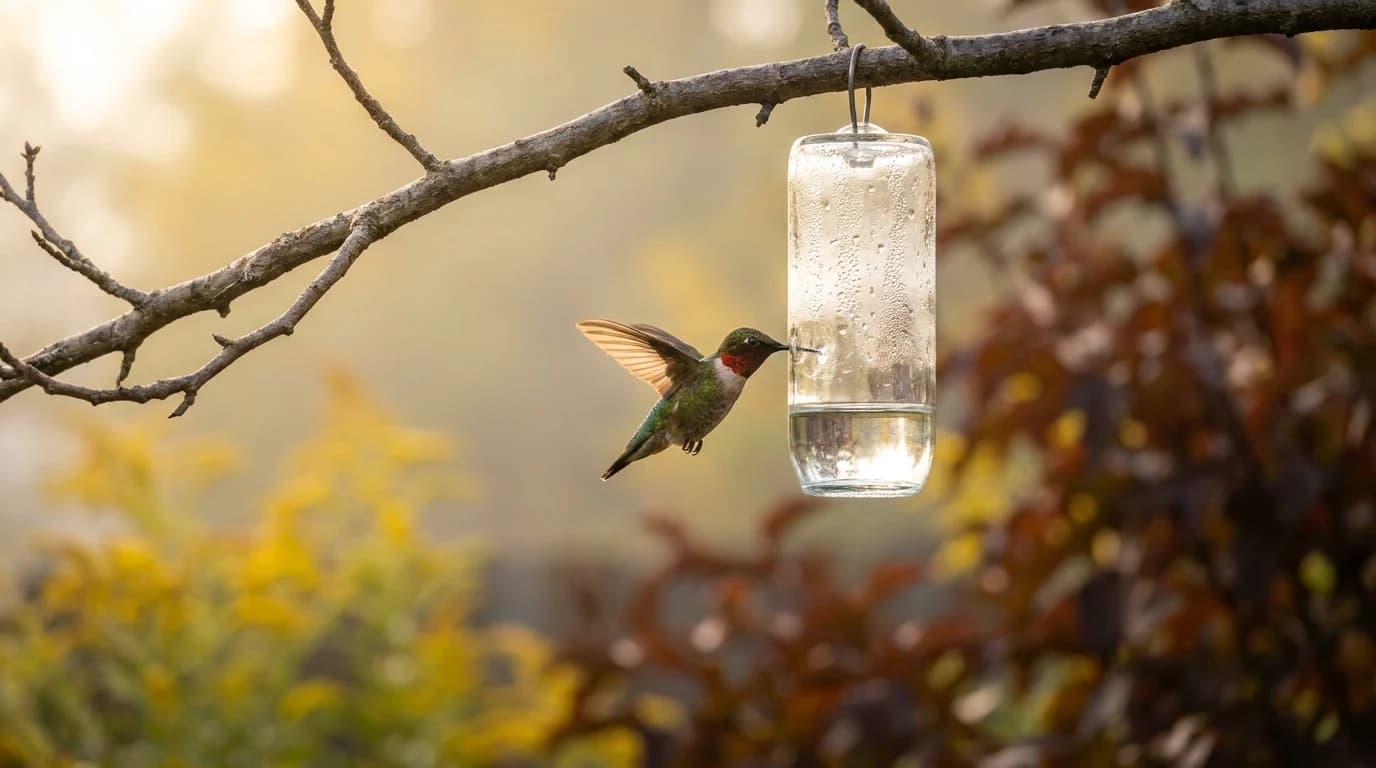
Key takeaways
- Your feeder cannot keep a hummingbird from leaving. Audubon states that hummingbirds are genetically programmed to head south, cued by day length and the angle of the sun rather than by food or cold.
- The rule is a stopwatch, not a date. Audubon's guidance is to keep feeders up for two weeks after the last bird you see; Ohio State Extension says through October, or until visits stop.
- On the Pacific coast the correct answer is to do nothing. Anna's Hummingbird is resident from northwestern Baja California to British Columbia, so year-round feeding is right there — not a mistake.
- The myth is a retired expert opinion, not folklore. Early advice really did warn against fall feeders; banding records of wintering western hummingbirds overturned it.
The question arrives every August, usually phrased as guilt: if I leave the hummingbird feeder up, am I keeping the birds from going?
You are not. That has been the settled answer for a long time. What almost nobody tells you is that this myth is not internet folklore — it is a fossil of advice real experts once handed out, and how it collapsed tells you more about your September yard than the myth-bust does.
The myth was once the careful position
Audubon's account of western hummingbirds turning up in the winter Southeast records that early expert advice genuinely did warn against leaving feeders out past fall, on exactly this reasoning: a feeder would tempt a bird into staying, and then kill it. Louisiana bander Nancy Newfield questioned the assumption and banded the birds that showed up anyway. Christmas Bird Counts before the 1970s logged two or three western hummingbirds a season; by the 1980s and 1990s the numbers had climbed enough that the old advice looked backwards.
If you inherited this rule from a neighbour or a feeder box, you inherited what was once the responsible position. It simply lost.
What actually sets the departure clock
Audubon's feeding FAQ answers it flatly: hummingbirds are genetically programmed to head south, and what tells them it is time is the changing length of the day and the angle of the sun — not a shortage of nectar, and not a cold snap.
The strongest evidence is not a lab study but a pattern you can check yourself. Audubon field editor Kenn Kaufman makes the argument with two birds that leave in the middle of plenty:
- Adult female Short-billed Dowitchers are flying south from the Arctic by late June, quitting the tundra while food is at its most abundant.
- Adult Orchard Orioles start leaving northern breeding areas by the first of August, checking out at the peak of summer.
His conclusion: feeders will not change the habits of ordinary summer residents, or of migrants passing through on schedule.
The test that settles it: if an entire landscape of natural food will not hold a bird past its departure date, one glass bottle of sugar water is not going to.
Ohio State University Extension gives the actionable version. Leaving feeders up through migration season does not encourage hummingbirds to stay; what a full feeder does is hand fuel to a bird about to attempt something enormous. One preparing to migrate fattens from roughly three grams to more than five — from the weight of a penny to the weight of a nickel.
So when do you take it down?
Two published rules exist, and they agree. Audubon says keep feeders up for two weeks after you see the last bird using one; Ohio State says leave them up through October, or until you stop seeing visitors. Pick whichever you will actually follow, then find your row:
| Where you are | This fall | Why |
|---|---|---|
| East, Midwest, mid-Atlantic (Ruby-throated) | Two weeks past your last sighting; through October is a fair default | Late migrants and juveniles trail the adults |
| Northern tier and most of Canada | Same rule — your last bird just comes earlier | The clock starts at your last sighting, not a date |
| Gulf Coast, southern Arizona, south Florida | Leave it up | Several species regularly overwinter there |
| Pacific coast, Baja north to British Columbia | Leave it up, all year | Anna's Hummingbird is resident, not migratory |
| Coastal Southern California | Leave it up, all year | Allen's Hummingbird is resident too |
| Anywhere, one bird still around in late fall | Leave it up | Far more likely a lost vagrant than a bird you trapped |
Note what that two-week rule actually measures. It is not a calendar date — it is a stopwatch started by the last hummingbird you see, which is why a Vermont yard and a Georgia yard follow the same rule and take feeders down a month apart.
The West Coast reads this question backwards
Between northwestern Baja California and British Columbia, the whole takedown conversation is aimed at somebody else. Audubon lists Anna's Hummingbird as resident across that entire stretch, Allen's as resident in coastal Southern California, and Costa's from Baja through southeast California to western Arizona. Oregon State University Extension says the same for the Pacific Northwest: Anna's can be seen year-round.
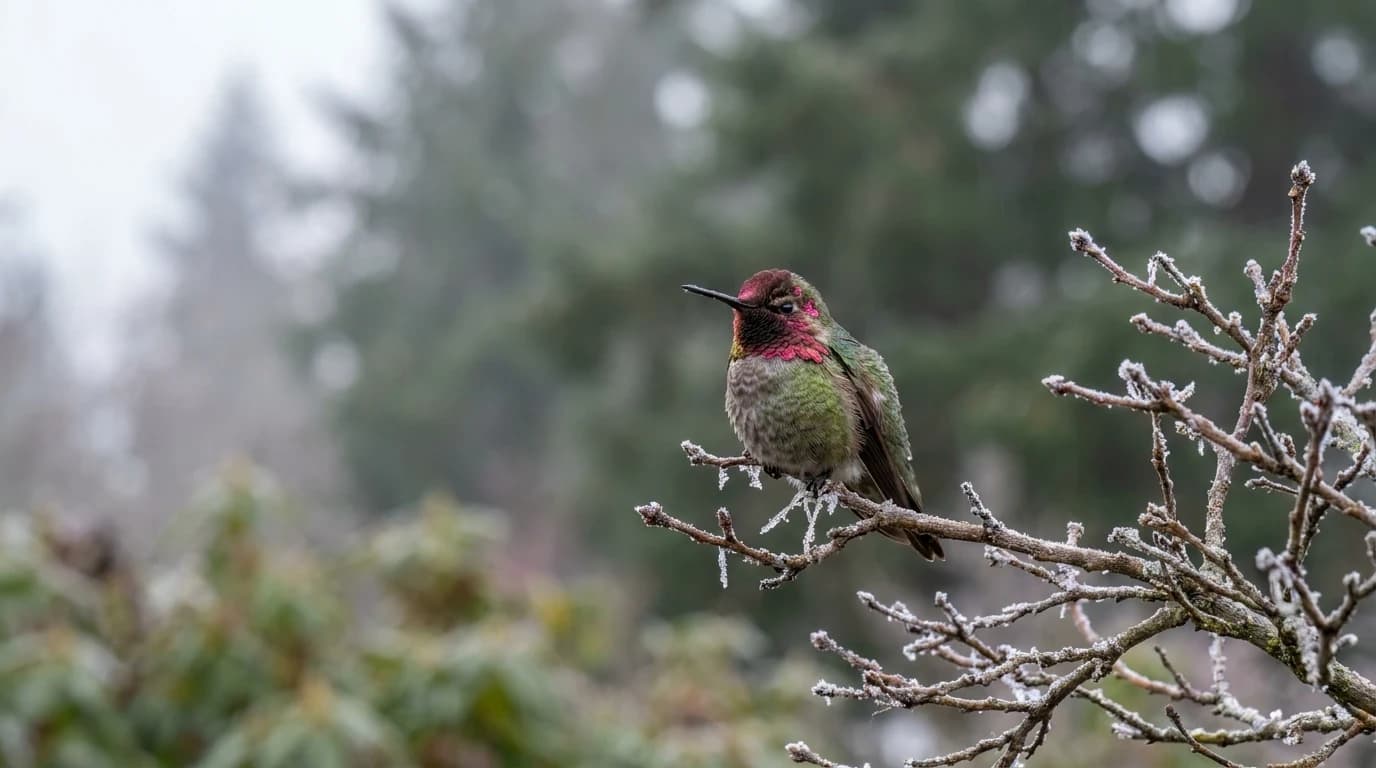
If your hummingbirds leave:
- Start the two-week clock at your last sighting.
- Keep the nectar fresh through those two weeks — a stale feeder is worse than none.
- Clean, dry and store it; get it back out a week or two before spring arrivals.
If your hummingbirds do not leave:
- Do not take it down at all. Audubon's answer to year-round feeding where birds stay year-round is a plain yes, with the usual cleaning discipline.
- Expect torpor on cold nights. A normal body temperature of about 102°F can drop 20°F in shallow torpor and 40°F in deep torpor, so a bird emerging from that on an icy morning is running on empty.
- Copy Oregon State's hedge, which is carefully worded: it is believed that feeders add to a hummingbird's food supply rather than making it dependent.
The nuance every myth-bust page skips
Here is where the flat "feeders don't affect migration" answer gets too blunt to be honest.
Your feeder will not delay one hummingbird by a single day. But feeders, collectively, over decades, moved a species. Anna's Hummingbird was once a bird of southern California and Baja; since the 1930s it has spread north to British Columbia and east to Texas. Audubon reports a study finding the birds colonise new places — even cold ones — based on housing density plus flowery landscaping and nectar feeders, and Oregon State attributes the same expansion to urban plantings with year-round blooms alongside warming temperatures.
Both things are true: no individual bird stays because of your feeder, and feeders helped redraw the winter map of an entire species. The honest answer is not "feeders don't matter" — it is "feeders don't override an internal clock."
The straggler is the whole point
The best reason to leave a feeder up is the bird you were most afraid of trapping. Kaufman's example is exact: eastern Pennsylvania's first-ever Anna's Hummingbird arrived in October 2010 and stayed the winter while neighbours put up extra feeders to help it along. Birds like that are not being held back. Their internal compass is already broken, and sugar water is the only thing improving their odds.
So in the last weeks of your season, do four things and stop worrying about the fifth:
- Keep the ratio at one part white sugar to four parts water. No dye, no honey, no substitutes — our nectar calculator scales it to any batch, and the setup guide covers the rest.
- Keep changing it. Audubon's cadence is every day or two in hot weather, every three days in temperate weather, twice a week when it cools.
- Actually scrub it, not just rinse it — the same routine as any other feeder you own. If yours will not come apart, start over from our hummingbird feeder picks — the Aspects HummZinger HighView (on Amazon) is the open-saucer benchmark we point people to for exactly this reason.
- Write down the date of your last sighting. It is the number the two-week rule runs on, and next spring it tells you when to hang the feeder again.
The one thing not on that list is the takedown deadline you were worried about. There isn't one, and there never was. For the wider version of what September is doing to your yard, fall migration is the bigger story your hummingbirds are one thread of.
Planning for next spring?
Frequently asked
Will leaving my hummingbird feeder up stop the birds from migrating?+
No. Audubon's hummingbird feeding FAQ says hummingbirds are genetically programmed to head south and know it is time from the changing length of the day and the angle of the sun, not from a lack of nectar or a drop in temperature. Ohio State University Extension calls the opposite belief a common misconception. Birds that leave at the peak of summer food supply, such as Orchard Orioles departing northern breeding areas by the first of August, are the clearest evidence that abundance does not hold a migrant in place.
How long after the last hummingbird should I leave the feeder up?+
Audubon's guidance is two weeks after you see the last bird using it. Ohio State University Extension frames the same idea as leaving feeders up through October, or until you no longer see hummingbirds visiting. Because the count starts at your own last sighting rather than a calendar date, the actual takedown day varies by weeks between a northern and a southern yard.
Do I need to take my feeder down at all if I live on the West Coast?+
No. Anna's Hummingbird is a year-round resident from northwestern Baja California along the Pacific coast to British Columbia, and Allen's Hummingbird is resident in coastal Southern California. Oregon State University Extension notes that Anna's can be seen year-round in the Pacific Northwest. Audubon's answer to feeding year-round in places that have hummingbirds year-round is an unqualified yes, provided you keep the feeder clean.
A hummingbird is still visiting in November. Did my feeder trap it?+
Almost certainly not. Kenn Kaufman describes these birds as individuals whose internal compass has failed rather than birds held back by a feeder; eastern Pennsylvania's first recorded Anna's Hummingbird arrived in October 2010 and spent the winter while neighbours added feeders to support it. Several hummingbird species also regularly overwinter along the Gulf Coast, in southern Arizona and in south Florida. Leaving the feeder up and the nectar fresh is the helpful response.
Sources & further reading
We research from primary and authoritative sources. Where our guidance rests on a fact, here's where it comes from.
- Hummingbird Feeding FAQs | Audubon — Hummingbirds are genetically programmed to head south, cued by day length and the angle of the sun; year-round feeding is fine where birds are resident; Anna's resident Baja California to British Columbia, Allen's in coastal Southern California, Costa's Baja to western Arizona; several species overwinter on the Gulf Coast, southern Arizona and south Florida; 1:4 sugar-to-water and the cleaning cadence.
- Ask Kenn Kaufman: Will My Feeder Keep Birds From Migrating? | Audubon — Feeders do not change the habits of summer residents or normal migrants; Short-billed Dowitchers leave the Arctic by late June and Orchard Orioles by 1 August, at peak food; the eastern Pennsylvania Anna's Hummingbird of October 2010 that wintered on neighbourhood feeders.
- How to Create a Hummingbird-Friendly Yard | Audubon — In fall, keep feeders up for two weeks after you see the last bird using one.
- Do you know when to take down your hummingbird feeder? | Ohio State University Extension — Calls the migration-delay belief a common misconception; leave feeders up through October or until visits stop; a full feeder supplies fuel for the journey.
- Hummingbird visitors to Pacific Northwest gardens | Oregon State University Extension — Peer-reviewed OSU Extension publication (Feb 2025): Anna's seen year-round in the Pacific Northwest and expanding on urban plantings and warming temperatures; torpor drops a 102F body temperature by 20F shallow, 40F deep; migrants fatten from about 3g to over 5g; feeders are believed to add to food supply rather than create dependence.
- Anna's Hummingbirds Are Expanding Their Range With Human Help | Audubon — Once found only in southern California and Baja; since the 1930s north to British Columbia and east to Texas; a study found colonisation of new, even cold, sites tracks housing density plus flowery landscaping and nectar feeders.
- Rufous Hummingbirds Turning Up in Unusual Places | Audubon — Early expert advice warned against leaving feeders out past fall; bander Nancy Newfield questioned it; Christmas Bird Counts logged only two or three western hummingbirds a season before the 1970s, rising through the 1980s-90s.
Prices and BirdingScores reflect our most recent research and refresh on a cycle; confirm the live price before buying. We may earn a commission from affiliate retailers — it never changes our recommendations. See how we review.