
How to Clean Binocular Lenses Without Scratching Them
Remove grit before wiping binocular lenses. A safe cleaning sequence, what to avoid, and when fog or marks need manufacturer service.
Key takeaways
- Remove loose dust and sand before any wiping; if that solves the problem, skip wet cleaning.
- Use the material and fluid approved for your model, with a clean cloth or fresh lens tissue. Clothing and ordinary tissue can scratch.
- Persistent internal haze or a double image needs service advice. Do not open sealed lenses, and dry the exterior before storage.
First, work out what needs cleaning
A few specks on the outside of a lens do not automatically call for a full cleaning. Inspect the objective lenses at the front and the eyepieces you look through. Is the problem loose dust, a fingerprint, or haze that seems to sit behind the glass? Those need different responses.
This guide covers exterior care, not optical repair. Nikon's maintenance guidance puts dust removal before wiping and warns that ordinary tissue can scratch lens surfaces. Read the instructions for your exact model before choosing a cleaner, especially for older optics or specialized coatings.
| What you see | First action | Stop if… |
|---|---|---|
| Loose dust or grit | Remove it with a clean, soft lens brush | Grit remains stuck to the surface |
| Fingerprint or oily smear | Use the maker's approved cleaning method after dust removal | Repeated light cleaning does not shift it |
| Haze behind the glass | Contact the manufacturer or an optical repair service | You are tempted to remove a lens or seal |
Use the least cleaning that works
Bring the binoculars indoors to a clean workspace. Keep their strap secure so they cannot fall while you work. Have the model's care instructions, a clean lens brush, an optical cloth or lens tissue, and a compatible cleaning fluid if needed.
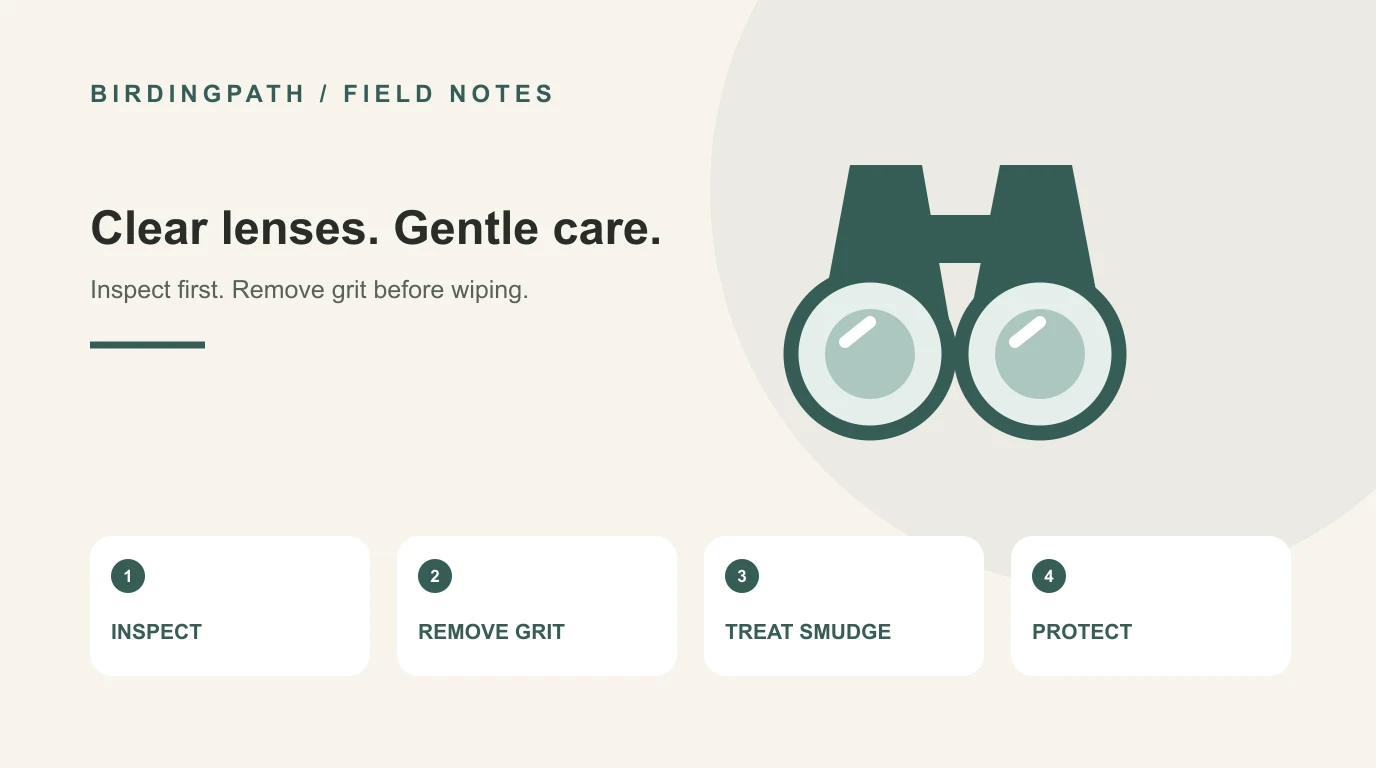
- Remove loose particles first. Use a clean, soft, oil-free lens brush without pressing grit into the glass. Do not start by rubbing the lens.
- Check again. If dust was the only problem, stop. A cleaning routine does not need a wet stage every time.
- Treat a remaining smudge gently. Follow the manufacturer's fluid and cloth instructions. Use a clean part of the cloth; do not scrub a mark harder because it is persistent.
- Inspect and protect. Check the view, let the exterior dry as directed, and replace the caps before carrying the binoculars.
Order matters: removing grit comes before wiping. Cleaning harder is not the next step when a mark will not move.
Keep the cloth cleaner than the lens
An optical cloth stored loose in a pocket can collect the same dirt you are trying to remove. Keep it in a clean pouch and follow its washing instructions. Replace disposable lens tissue after use rather than carrying a dirty piece to the next lens.
Useful habits:
- Cap the lenses between outings.
- Reserve a cloth for optics and keep it protected.
- Read the model's manual before using a chemical cleaner.
Shortcuts to skip:
- A shirt, paper towel, or ordinary facial tissue.
- Wiping over visible sand or grit.
- Assuming every glasses cleaner is suitable for every binocular coating.
- Unscrewing parts to reach a mark inside the instrument.
An optics product explicitly labelled for binoculars is a better starting point than household glass cleaner, but the binocular maker's instructions still take priority. For example, ZEISS identifies its optical wipes as suitable for binoculars and coated lenses; that does not make every wipe interchangeable.
Wet binoculars need the right manual
Waterproof, water-resistant, and unspecified are different descriptions. Do not submerge or rinse an instrument merely because it looks rugged. Nikon gives particular exterior-rinsing instructions for its waterproof models after seawater or muddy-water exposure; follow the instructions for your model rather than extending that advice to all binoculars.
Dry a wet exterior before storage. Nikon also warns against leaving damp binoculars in their case, where trapped moisture can encourage mold. A dry storage place matters as much as a clean lens.
Stop point: persistent internal fog, a loose optical part, or a double image calls for service advice. Exterior cleaning cannot fix alignment or a damaged seal.
Check the view before replacing the binoculars
If the lenses look clean but the image is uncomfortable, setup may be the issue. Follow our focus and diopter walkthrough, or use the glasses-fit checklist if black rings appear around the view.
You do not need a new pair just because the old one needs care. If service identifies a problem that makes replacement sensible, the binocular finder can filter the existing catalog by budget and basic fit requirements.
Once the lenses are clean, check the fit and focus before buying anything new.
Frequently asked
Can I clean binocular lenses with my shirt?+
Avoid it. Clothing can carry grit, and rubbing particles across a lens can scratch it. Remove loose dust first and use the lens material recommended by the manufacturer.
Can I use eyeglass cleaner on binoculars?+
Only if the binocular manufacturer permits it for that model and coating. Check both the cleaner label and the binocular care instructions; a household glass cleaner is not an automatic substitute.
What if the fog is inside the binoculars?+
Exterior wiping will not reach it. Let the instrument reach normal room conditions and consult its manufacturer if the haze persists. Do not open sealed optical parts yourself.
Sources & further reading
We research from primary and authoritative sources. Where our guidance rests on a fact, here's where it comes from.
- Nikon: binocular precautions, cleaning and storage — Dust/sand removal, gentle smudge cleaning, ordinary-tissue warning, moisture storage, and model-specific waterproof exterior care.
- ZEISS: optical lens wipes and compatible surfaces — Manufacturer describes these wipes as suitable for binoculars and coated optical lenses; exact-binocular instructions still take priority.
Prices and BirdingScores reflect our most recent research and refresh on a cycle; confirm the live price before buying. We may earn a commission from affiliate retailers — it never changes our recommendations. See how we review.