
Using Binoculars With Glasses: Eye Relief and Fit
Keep your glasses on, retract the eyecups, and check the whole view. A practical eye-relief and blackout checklist before buying binoculars.
Key takeaways
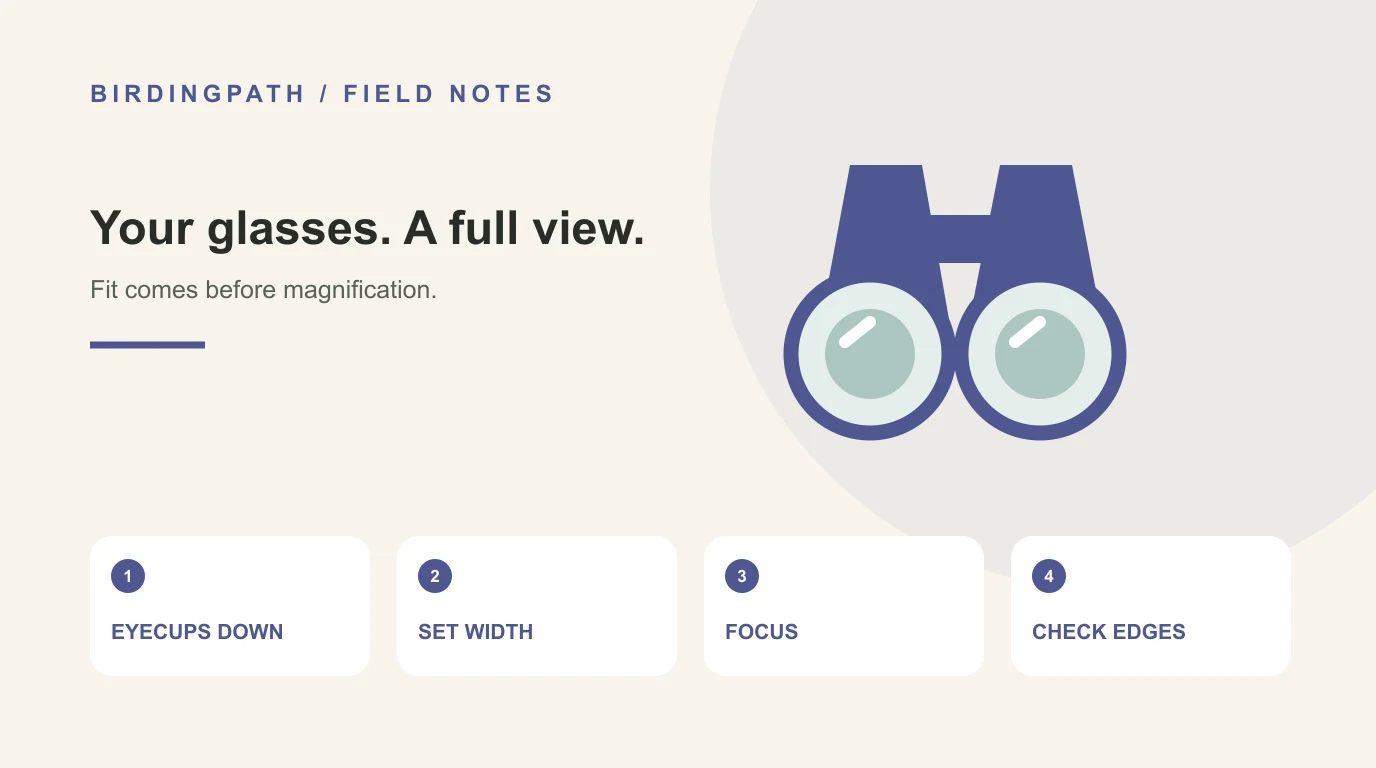
- Start with your usual glasses and retracted eyecups, then set hinge spacing until both views merge into one circle.
- The finder uses 15 mm of listed eye relief to shortlist; frames and eyecup shape still determine whether you can see the full field.
- Repeat lowering and raising each pair with the same target. Correct fit and focus before treating blackouts as a magnification or cleaning problem.
Start with the glasses you actually wear
You can use binoculars while wearing glasses. Eye relief is the distance from the eyepiece to the eye position that shows the full field. The practical question is whether your glasses let your eyes reach that position comfortably, without pressing the binoculars against your lenses.
Cornell's binocular adjustment guide recommends retracting the eyecups for glasses wearers. Start there with your everyday frames or the sunglasses you bird in. A pair that works with one frame may feel different with another; check your own setup rather than relying on someone else's comfortable fit.
Do this fitting sequence before comparing models
Pick a stationary, detailed object at a comfortable distance. Use the same target for each trial. Do not use the sun or look toward it through binoculars.
- Retract the eyecups. Bring the binoculars up gently without pushing against your glasses.
- Set the barrel spacing. Move the center hinge until the two views overlap into one circle.
- Focus, then set the diopter. Follow your model's instructions. The main focus and the diopter do different jobs; turning both at random makes comparison harder.
- Inspect the edge. Can you see the field comfortably, or are you looking down a narrow tunnel?
- Lower and raise the binoculars again. Repeat the fit rather than judging only the one position you managed to hold.
The repeated raise is our suggested practical check, not a measured product test. A fit you can find comfortably is more useful than a specification you cannot reproduce in use.
Eye relief is a filter, not a promise
A published eye-relief figure tells you where the intended viewing position lies behind the eyepiece. Frames and eyecup shape affect where your eye actually ends up. Nikon's setup guidance explains how eyecup position and diopter adjustment work together; it does not turn one number into a universal guarantee.
Our binocular finder uses at least 15 mm of listed eye reliefHow far your eye can sit from the eyepiece and still see the full image — 15mm+ matters if you wear glasses. as an initial glasses screen. That is an editorial shortlist rule. It does not mean every pair at 15 mm will fit, or that a missing specification proves a pair cannot work for you.
| Observation | What to check next | What it does not prove |
|---|---|---|
| A narrow circular view | Eyecups fully retracted; glasses-to-eyepiece spacing | That you need more magnification |
| Two separate circles | Hinge width and alignment with your eyes | That the lenses are dirty |
| One side looks less sharp | Focus and the model's diopter procedure | That the whole binocular is defective |
| Dark areas appear as you move | Eye position, eyecup setting, and barrel spacing | That a larger objective will fix the fit |
Fit before features: a wider advertised field is useful only if you can see it comfortably through your own glasses.
Compare the view, not just the label
Useful comparisons:
- Use the same target and your usual glasses for each pair.
- Check the center and edges while holding the binoculars normally.
- Try lowering and raising them without changing the setup.
- Confirm the seller's current return terms before buying remotely.
Less useful shortcuts:
- Picking the largest eye-relief number and assuming fit is solved.
- Removing your glasses for every trial when you plan to wear them outdoors.
- Pressing hard against your frames to force a full circle.
- Treating more magnification as a cure for blackouts.
We have not physically tested these pairs for your fit. The mid-range comparison shows researched specifications; the 8×42 versus 10×42 guide tackles magnification separately. Keep those decisions separate: first a usable view, then the detail and field of viewHow wide a scene you see through the glass, usually given as feet at 1,000 yards — wider makes finding flitting birds easier. you prefer.
What if the view is still wrong?
Repeat the setup slowly and consult the manual for the exact model. If possible, ask a retailer to check your adjustment with you. Persistent double images or discomfort after correct setup deserve an equipment check rather than more force or repeated cleaning.
For a step-by-step explanation of center focus and the diopter, continue with how to use binoculars for birding. If fingerprints are visibly affecting the lenses, use our lens-cleaning sequence before comparing the view again.
Separate fit from magnification, then compare only the specifications you need.
Frequently asked
Should I leave my glasses on when using binoculars?+
You can. Start with your usual glasses on and the eyecups retracted, then adjust barrel spacing, focus, and the diopter. Try the actual combination you plan to use outdoors.
Is 15 mm of eye relief enough for glasses?+
It is a useful starting screen, not a guarantee. Eyecup shape, frame spacing, and your face affect usable eye relief. Check that you can see the full field comfortably with your own glasses.
Why do I see black circles through binoculars?+
Check eyecup position, barrel spacing, and where your eyes sit behind the eyepieces. For glasses wearers, start with the eyecups retracted. Blackouts alone do not prove the lenses are dirty or that you need more magnification.
Sources & further reading
We research from primary and authoritative sources. Where our guidance rests on a fact, here's where it comes from.
- Cornell Lab: adjusting binoculars to avoid blacked-out areas — Explains eyecup, hinge and diopter adjustments and why glasses wearers usually retract eyecups.
- Nikon: adjusting binoculars and eye relief — Manufacturer setup sequence for glasses, eyecups, center focus and diopter; not a universal eye-relief threshold.
- Cornell Lab: choosing binoculars that fit — Encourages trying binoculars for personal fit and checking the full field with the glasses you wear.
Prices and BirdingScores reflect our most recent research and refresh on a cycle; confirm the live price before buying. We may earn a commission from affiliate retailers — it never changes our recommendations. See how we review.