
Why Do Birds Sing in the Morning? The Real Reasons
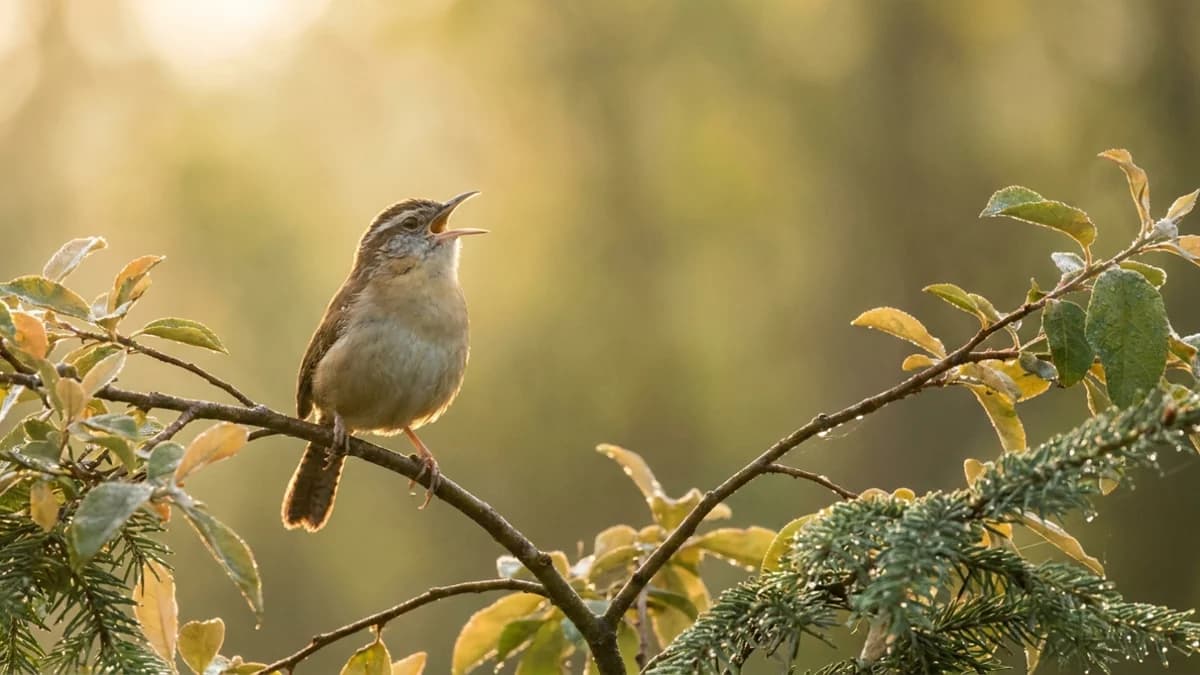
Birds sing most at dawn to defend territory and attract mates, when still air carries sound far and it's too dim to forage.
Key takeaways
- Two main jobs. Dawn song is largely about defending territory and attracting a mate — the loudest, clearest broadcast of the day.
- Timing is efficient. It's too dim to forage at first light, so singing fills otherwise idle time.
- Singing at dawn is a fitness signal. A male belting it out has survived the night and is well-fed enough to spend energy on song.
- The 'sound travels farther' idea is contested. A 2025 study questioned it, so treat calm air as one factor among several, not the whole story.
Birds sing most at dawn mainly to defend territory and attract mates — the two jobs that decide whether a male breeds this season. Everything else is a supporting reason.
At first light it's still too dark to hunt insects or spot seeds, so singing fills time that can't be spent feeding. The air is usually cool and still, with less wind and daytime noise. And a male singing strongly at daybreak is quietly announcing he made it through the night — a hard thing to fake.
The leading explanations, side by side
No single reason wins. Researchers weigh several, and the evidence for each varies.
| Theory | What it says | Evidence |
|---|---|---|
| Territory defense | Song warns rival males to stay out | Strong — playback of a rival's song reliably provokes a response |
| Mate attraction | Females judge males on song quality and stamina | Strong — females often prefer bigger, more complex repertoires |
| Too dim to forage | Low light makes feeding inefficient, so birds sing instead | Good — song peaks before feeding activity ramps up |
| Sound carries farther | Calm, cool dawn air lets song travel | Contested — a 2025 study (discussed by Cornell/NPR) found the effect may be smaller than long assumed |
| Honest 'I survived' signal | Singing at dawn proves a male is fit and well-fed | Growing support — links song to a bird's condition |
Why the old 'sound travels farther' story got a rethink
Calm air helps a little; honesty helps more
For decades the tidy explanation was that still dawn air carries song best. A 2025 study questioned how big that advantage really is.
The likely truth is layered: calm air may help a little, but information and honesty matter more — dawn is simply the best moment to broadcast "this territory is taken" and "I'm still here."
Pro tip: don't look for one reason. The dawn chorusThe burst of concentrated bird song around sunrise, when males sing to defend territory and attract mates. is several pressures stacking up at the same hour — defense, courtship, spare time, and a fitness flex all at once.
What is the dawn chorus?
The dawn chorus is the wave of song that rolls through just before and after sunrise, loudest in spring and early summer across the US and Canada.
It's most intense during breeding season, when territory and mating stakes are highest, and it fades as the day warms and birds shift to feeding.
Why species start in a predictable order
Eye size, not eagerness, sets the running order
Birds don't all begin at once. The chorus builds in a rough, repeatable sequence, and light is the main cue.
Who opens in near-darkness:
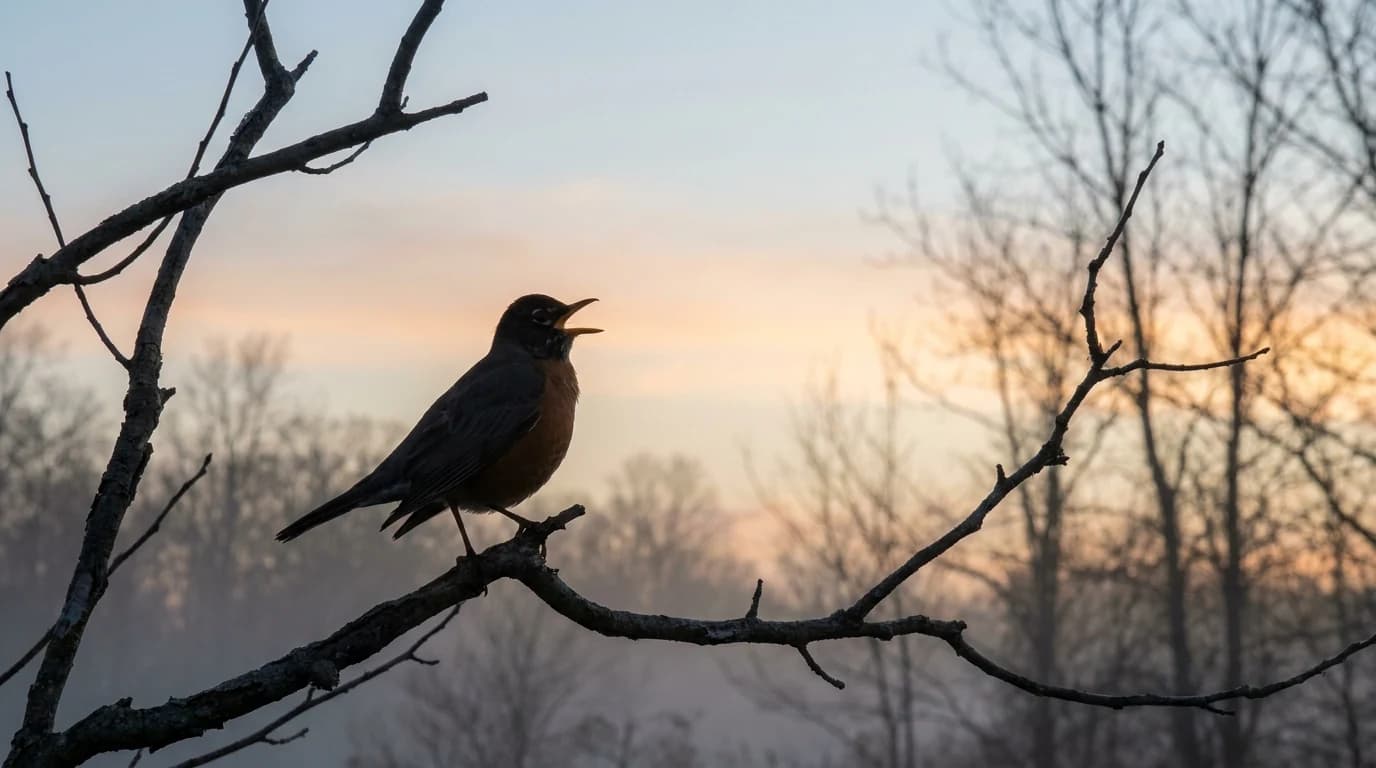
- Big-eyed early risers. Species like American Robins and thrushes have larger eyes that gather dim light, so they start before there is anything to see.
Who waits for the light:
- Smaller songbirds. Warblers, finches, and sparrows join as it brightens.
- Later feeders. Birds that rely on good light to forage tend to sing after the first wave.
Habitat and each morning's cloud cover shift the exact timing, but the order stays surprisingly consistent in one spot.
How to tell who's singing
An app is the shortcut; your ears are the goal
Once you notice the order, the natural next question is which bird is which — and you don't need to memorize songs to find out.
- Merlin Sound ID (free, from the Cornell Lab) listens through your phone and suggests species in real time — the easiest starting point.
- For a hands-off setup, an always-on listener like the Haikubox logs your yard's dawn chorusThe burst of concentrated bird song around sunrise, when males sing to defend territory and attract mates. 24/7 and builds a species list for you (see it on Amazon).
- Want to record and study songs yourself? Browse honest picks in bird-song identifiers.
Rule of thumb: start with the three or four voices you hear most each morning. That handful covers the bulk of your local chorus, and the rest gets easier fast.
Does morning singing change through the year?
Song fades to call notes after breeding
Yes — a lot. Dawn song is loudest and most crowded in spring, when birds are pairing up and staking claims, and it thins out as summer ends.
- Spring peak: the fullest chorus, driven by breeding.
- Late summer: quieter, as many birds finish nesting and molt.
- Fall and winter: far less true song; more short calls used to stay in contact and hold winter territory.
Across the US and Canada, that spring surge tracks the return of migrants and lengthening days, so your local chorus peaks a little later the farther north you live.
The quick takeaway
When you hear that wall of song at daybreak, you're mostly hearing males claiming ground and courting mates in the one window when it's too dark to feed and the air is calm.
It's the busiest, highest-stakes broadcast of a bird's day, and learning even a few voices turns it from background sound into a morning worth waking up for.
Want to know which bird is singing?
Frequently asked
Why do birds sing so early in the morning?+
Because dawn is the best time to defend territory and attract mates, and it's still too dark to feed efficiently. Cool, calm air may help song carry, and singing at first light also signals that a bird survived the night in good condition.
What is the dawn chorus?+
It's the burst of bird song around sunrise, strongest in spring and early summer during breeding season. Species tend to join in a predictable order, with large-eyed early risers like robins starting in near-darkness and smaller songbirds following as it brightens.
Why do birds sing at night?+
Some do naturally, like mockingbirds and whip-poor-wills, especially unmated males advertising for a partner. In towns, artificial light and quieter nighttime traffic can also nudge normally daytime singers, such as robins, into singing after dark.
Do female birds sing?+
Yes, more often than the old textbooks claimed. Female song is common in many species and is likely the ancestral state for songbirds, though in much of North America the loudest dawn singers are still territorial males.
Sources & further reading
We research from primary and authoritative sources. Where our guidance rests on a fact, here's where it comes from.
- A New Study Knocks Down a Popular Hypothesis About Why Birds Sing at Dawn | NPR — The 2025 research the article cites — challenges the 'sound travels farther at dawn' hypothesis; social factors dominate.
- Study Reveals Why Birds Sing More at Dawn in Tropical Forests | Cornell Lab of Ornithology — Cornell Lab's own writeup of the 2025 study finding territoriality and feeding habits, not acoustics, drive dawn song.
- Who Sings First During the Dawn Chorus—and Why? | All About Birds (Cornell Lab) — Supports the predictable order: large-eyed early risers (robins/thrushes) sing first in dim light, smaller songbirds follow.
- Eye Size in Birds and the Timing of Song at Dawn (Thomas et al.) | Proc. R. Soc. B (PMC) — Peer-reviewed source that large-eyed species sing at lower light intensities, backing the big-eyed-birds-first claim.
- Why Do Birds Sing So Loudly in the Morning in Spring? It's the 'Dawn Chorus' | National Geographic — Supports territory-defense and mate-attraction as the leading reasons and the spring/early-summer breeding peak.
Prices and BirdingScores reflect our most recent research and refresh on a cycle; confirm the live price before buying. We may earn a commission from affiliate retailers — it never changes our recommendations. See how we review.